30 May 2014
Friday Flag - Kingdom of Irondequoit
After a global war between the Fourth Roman Republic and Zhōngguó in 2766 AUC the world was in chaos. Billions died and civilization collapsed. One of the few cities not to be hit during the war was Genesee, a medium-sized city in Irokois Province of the Republic. A change in the jet stream and influence from the Great Lakes kept much of the fallout from the obliteration of nearby cities form killing everyone in Genesee.
After a harsh winter and no contact with Rome or any other authority, the military leaders in Genesee took control and formed the Kingdom of Irondequoit in the spring of 2767 AUC. Having some of the last tanks and military vehicles left functioning on the continent scouts were sent to the shattered remains of nearby provinces, mostly to the south and west, looking for survivors and territories to add to the new Kingdom.
Otetiani Lutatius Validus, the legatus legionis of the Genesee Legion, proclaimed himself dictator of this new nation. He introduced the new flag for his forces to serve under to build loyalty to him and to get them to forget about their former oaths to the old Republic.
The main goal of the Kingdom are to find arable land. The anticipated plagues, famine, and nuclear winters of the next few years are the main hurdle for the survival of the state. The limited supply of hi-tech parts and ammunition will be the the other challenge.
28 May 2014
Free City of Tri-Insula
| FREE CITY OF TRI-INSULA |
|
|---|---|
| Name: | Free City of Tri-Insula |
| Independence: | September 8, 1861 (from FFA) |
| Re-Conquest by FFA: | November 17, 1861 |
| Land Area: | 303 square miles (786 km) |
| Water Area: | 164 square miles (425 km) |
| Former NY Counties: | Manhattan, Bronx, Brooklyn, Queens, Staten Island |
| Population: | 813,669 |
| Major Ethnic Groups: | American, Irish, German, many others |
| Languages: | Officially English, dozens of others spoken |
| Government Type: | Mayor-Council |
| Executive: | Mayor Fernando Wood |
| Legislature: | Tri-Insula Council |
| GDP: | $358 million |
| Currency: | Tri-Unsula Dollar |
| Major Industries: | Trade, ship building, textiles |
After the 1860 US Presidential Election a number of northern states seceded from the United States of America and formed the Federation of Free America. When fighting broke out between the US and the rebels FFA President, Abraham Lincoln, began calling for the states to initiate a draft to raise troops. In August 1861 New York approved a draft that allowed for exemptions by those willing to pay $300 to the State.
The draft, and the general unpopularity of leaving the Union, caused Mayor Fernando Wood to call the city council together along with representatives form local governments of the five county area. He pushed a proposal to form an independent city-state that could easily survive on trade between the warring states alone. After long days of negotiations an agreement was reached. On September 8, 1861 the City State of Tri-Insula was born.
Lincoln was not amused. He felt that the states has the sovereign right to leave the Union, but a city had no legal standing to secede from a state. The need of New York Harbor and the manpower of the city led to an ultimatum being issued to Wood. Armies from New York State and New England were diverted to surround the rebellious city. After about two months of a siege the troops finally moved in. The Tri-Insulan milita was quickly scattered with the deaths of 57 FFA soldiers and 188 rebel militia, over 2,000 in total were wounded from all sides.
When the city was brought back into New York Lincoln was generous with pardons for most of those behind the uprising. Fernando Wood and his closest advisers were imprisoned until the end of the FFA war for independence.
NOTES
1) Secession in New York
2) Data from US Census Bureau
23 May 2014
Friday Flag - Anglo-Corsican Republic
Corsica declared its independence from the Most Serene Republic of Genoa in November 1755 under the leadership of Pasquale Paoli. With the formation of the new nation came one of the first codified national constitutions in modern history. Democratic reforms spread across the island and women were even allowed to vote.
Not being able to regain control of the secessionist island, the Republic of Genoa sold Corsica to France in 1768. The French, coming off the losses of the Seven Years' War, were desperate to gain some new territories. They quickly invaded to claim the land.
The British were on friendly terms with the Corsicans. When the French began their invasion First Lord of the Admiralty, Edward Hawke, convinced the Grafton Ministry of the value of Corsica at guaranteeing British power in the Mediterranean. The British deployed their fleet and an army to aid their allies against France. The Corsican victory at the Battle of Borgo encouraged the British.
Shortly after the British intervention the French gave up their claim to Corsica. With the independence of the island guaranteed by Britain things stabilized under an Anglo-Corsican Republic. British naval bases sprung up across the island. The Corsica kept its government and diet but also recognized Corsica's fealty to the British Crown. In 1855 the new flag of Corsica was revealed. Many inhabitants did not like the Union Jack being incorporated into the flag, feeling that they traded French masters for English ones.
One man who would hold this dislike for the flag would manage to suppress these feelings in order to take advantage of the opportunities to advance his military and political careers was the son of Carlo Buonaparte. Carlo was one of the personal assistants to Pasquale Paoli. His son was named Napoleone.
19 May 2014
Quantum Flux - Scandinavian Confederation
May 19, 2014
*In 1923 there was an attempt to create a confederation of Scandinavian states. In part it was meant to be a mutual protection league to secure themselves against Russian aggression. Political differences kept it from forming, but what if it actual was successfully created? That's where this alternate history begins.
*The successful creation of the Scandinavian Confederation in 1923 united Norway, Sweden, Finland, Kareliya, Denmark, Iceland, and Greenland. The Russian skirmishes with Kareliya that plagued the OTL were much reduced by the threat of the intervention of the rest of the Confederation.
*The stronger cooperation and free trade zone between the member states also helped the Confederation become one of the first European nations to emerge from the global depression of 1925-1929. This improved economic situation kept Kareliya from falling into chaos during communist revolutions in 1927. There were some uprisings and riots, but they were easily contained.
*The Confederation held strong and would only meet a true test in the 1980s. The wealth brought in by the growing oil industry began to disrupt the traditional way of life. Large oil corporations, both Scandinavian and international, were gaining more and more influence. Not all regions profited and cultural changes were pushing some in Iceland in Finland to call for secession. The confederation held, concessions given to reduce the chance of secessionists.
*Other troubles during this time period were the large increase of Russian immigrants coming to work the oil fields and platforms. This added an additional element to the cultural changes of the '80s and '90s.
*By 2000 unrest in the Confederation dies down. Increased oil production by other nations and a new generation of Scandinavians helped their nations to adapt to the increasingly complicated world.
*In 2014 a more peaceful Russia has helped insure the peace for the Confederation. The oil reserves are even larger than were estimated in the '80s ensuring the near future of the economy. However at some point either supply or demand of the oil will die down. Hopefully when that day comes the Scandinavian Confederation will be prepared.
The Quantum Flux series of posts are from the point of view of an alternate history blogger in an alternate timeline; the Baltic Event timeline to be specific.
16 May 2014
Friday Flag - Deutsch Kuba
In the 1890s the German Empire acquired Cuba as a colony from Spain. Despite protests from the United States and other nations the crisis never evolved into armed conflict. While the Kaiser believed the new colony would aid in economic expansion into Latin America it did not bring much into the imperial coffers. The sporadic rebellions and needed infrastructure upgrades were a drag on the colony's economy.
Germany remained in possession of Cuba until the end of the Great War. After the war Cuba gained its independence.
14 May 2014
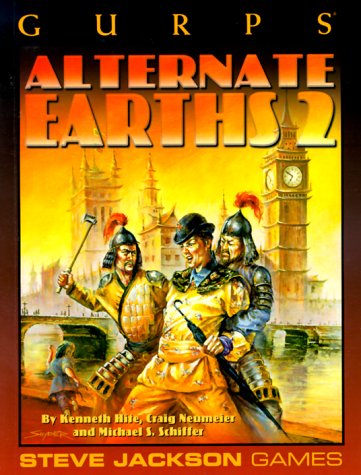
Book Review - GURPS Alternate Earths 2
This is another great GURPS book. A sequel to GURPS Alternate Earths. It introduces six new timelines and lots of other crunchy bits.
NEW WORLDS
Cornwallis
The British keep the French from interfering with the American Revolution. The revolution fails. In the early 19th century Tecumseh forms a confederation that is recognized as a subject nation of the Empire. Changes continue over the decades.
By 1983 the British Empire spans the Cape Colony, St. Louis (this timeline's name for Australia), and large portions of North America, along with scattered islands. They are by far the most powerful nation on Earth. The Russian Empire is doing well for itself as well, having kept Alaska and adding Manchuria and Japan to its territories.
All is not well. Without a successful American Revolution representative government never spread. The various empires and kingdoms spend much time crushing revolutions and their technology is a little behind the OTL in 1983.
Ming-3
The Chinese treasure fleets are never disbanded. The Chinese continue to explore and expand their influence across the seas. Violent encounters with the Portuguese required a demonstration of imperial power. By 1519 one of their fleets arrives in Lisbon, Portugal to deliver an ultimatum.
Growth of the Chinese territory continues. By 1859 well over half the world is controlled by them. All of eastern Asia, all of Australia, eastern and southern Africa, most of Europe (except for Russia), Central America as well as the west coasts of both North and South America.
Midgard
In 860 the Vikings successfully raid Constantinople. The vast wealth and new technologies they gain allow them to continue expanding their culture across the world. Numerous Viking nations are established as they have the resources to expand and develop colonies in Vinland.
The spread of knowledge of the new world allows others to cross the Atlantic. By the early 12th century Moslems settle in what in our world is Cuba. Within a few hundred years they add much of northern South America to a new Caliphate.
The Mongol invasion of Viking lands in 1237 are not as successful as in the OTL. In fact by the late 14th century the Golden Horde is finally destroyed.
By 1412 the world is a much different place than it is here. A very interesting world to adventure in.
Caliph
Technological advancement begins earlier in the Middle-East. By the ninth and tenth centuries the Abbasid caliphs have a scientific revolution. Oil replaces coal as a source of power and technology really begins to advance.
By the 13th century Islam is dominating much of the world. A global war between various states is fought in the early 14th century. All throughout this time technological progress marches on. Before the Spanish discovered the Americas in our timeline this one had a man landing on the moon!
Earth develops its first interstellar colony by 1568 and will contact alien life less than a century after that. By 1683 technology has advanced so far a visitor from our world would believe they had been transported to the far future.
Aeolus
William of Orange fails to take the English throne in 1688. The world continues to be controlled by squabbling monarchs. The concepts of liberty and democracy are never popularized until some writings in 1906.
In 1939 a republican uprising in Austria overthrows the Habsburgs (they flee to take control of Russia) and numerous small republics form. They form the Republican Alliance and are at war with Habsburg Russia. The weird bit is that the Republicans then invent combat aircraft, skipping propeller driven craft and going straight to primitive jets.
Centrum
An even more successful domination of the world by England. By 1902 there is an atomic war and much of the royal family is killed. Succession wars and rebellions send the world into chaos.
After the chaos died down a group called Centrum begins to restore order to the shattered world. With the discover of the ability to travel to alternate worlds they expand their mandate to bring order to other worlds as well.
In 2007 they are involved in what they call the Dimension War with a group calling itself Infinity. This world is a look a the home of the 'bad guys' from the Infinite Worlds setting in GURPS Time Travel. It's nice to have more details on the world they came from.
FINAL THOUGHTS
Another great GURPS supplement. I only wish that there was an Alternate Earths 3 (and 4 and 5 etc.). Some creative worlds with some details for basing a role-playing game around. Each of the Earths has notes on integrating and crossing over other GURPS products to expand and customize the campaigns.
Of course because of my bias in my love of RPGs and having run a GURPS alternate world campaign for three years I have to give this book 5 out of 5 stars.
If you ran an alternate world RPG campaign and used this book in the game please leave some details about it in the comments section. Thanks!
NOTES
GURPS Alternate Earths 2 was published by Steve Jackson Games
Page Count: 128
Authors: Kenneth Hite, Craig Neumeier, and Michael S. Schiffer
Year Published: 1999
ISBN: 1-55634-399-X
09 May 2014
Friday Flag - Kingdom of Burgundy
The Hundred Years' War went better for England and Burgundy. Philip the Good was less inclined to make peace with King Charles VII of France, blaming the king for the death of Philip's father. Philip had also gotten used to his lifestyle and knew it would be easier for him to maintain as a king than as a Duke under Charles.
The Third Kingdom of Burgundy has problems early on with the Church, there were many in the Church who did not want to see France split. The Holy Roman Empire was also a thorn in its side. Luckily none of the skirmishes between the two became an all-out war. The support of the English became important in such affairs, and this dependence did not please many in Burgundy.
When the 'New World' was discovered Spain and Portugal quickly moved to exploit South America. A diminished France would join them in the south. England and Burgundy became the dominate European powers in North America a century later.
Subscribe to:
Posts (Atom)