23 October 2015
Friday Flag - North Italy
During World War II the United States focused on battling Japan and attempting to retain territory lost in Asia. By the end of the war the Soviet Union pushed through all of Germany and into Northern Italy.
North Italy was quickly founded in 1947 as a communist state with South Italy an American proxy. Five years later the North invaded the South. North Italian, Polish, Czech, and a token German force crossed the border moving towards Rome. After being initially pushed back the allied forces (South Italy, USA, UK, Spain, and Turkey) got organized and pushed back. After nearly three years of fighting North Italy was defeated and occupied by the Allies.
The United States pushed for re-unification of Italy. The Soviets were not willing to escalate the situation over a small bankrupt country. Their nuclear program and delivery systems were still far behind the West and they needed time before any full-scale confrontation. Italy was reunited in 1955 and the flag of North Italy was retired.
21 October 2015
Happy Back to the Future Day
Happy Back to the Future Day..... and be thankful we don't live in that horrible future.
Flying cars, self-lacing sneakers, hoverboards, self-drying clothing, weather control, lots of cool stuff was depicted for the world of October 21, 2015 in Back to the Future II. However I haven't heard any mention of the most terrifying thing about this bright and colorful future; the lack of lawyers. Doc said: "The justice system works swiftly in the future now that they've abolished all lawyers. " That future is a terrible tyrannical world.
Lawyers get a bad rap. Sometimes they really deserve it. However in a free society lawyers are needed to help protect the innocent (and guilty) from the power of government. A world with instant justice and lack of police investigation of crimes is an evil place. Griff Tannen is a bully, thug, and was planning a crime but he ended up being imprisoned just for damaging the courthouse. Prison seems to be a harsh sentence for accidentally breaking some windows.
A totalitarian police state is not my idea of a great future, even with hoverboards.
I wish I could point to some things that show the alternate 1985 where Biff controlled Hill Valley wasn't as bad as it seemed. There was not enough information to show if the rest of the world was in a similar state. Who knows Marty's in that timeline off in boarding school might have led to a much better future. At least gambling was made legal in California.
The timeline changes in the trilogy were always fun and interesting. However the most terrible one for Marty was never addressed. That being the one at the end of the first movie. His entire life was changed. All of the memories of his family were no longer accurate and he now lives with complete strangers who inhabit the bodies of the family he loved. His name really shouldn't have been Marty anymore, his parents would have named their eldest son Marty. When our Marty became a teenager his father may have even divorced his wife after seeing that his son looked a lot like that Calvin Klein fellow they knew back in the day, and assumed that Lorraine had cheated on him with Klein. His mother would have then slipped back into alcoholism and possibly died sending the teenage Marty into foster care never to meet Jennifer...... In Star Trek Commander Spock would have been from some other planet and Star Wars' Darth Vader would have had a different name all because some writer named George McFly wrote a novel about Darth Vader from the Planet Vulcan in 1962.
Of course I'm over-thinking things a bit. I'm also drifting from the original point of the post: be thankful we didn't end up with the future portrayed in Back to the Future II.
09 October 2015
Friday Flag - Second Peru-Bolivian Confederation
After years of civil war and then a war with the United States the nation of Chile was in a weakened state. On 3 June 1884 Peru and Bolivia both declared war on Chile to reclaim lost territory. Despite Chile's weakness Peru and Bolivia were only in slightly better shape, having not fully recovered from the War of the Pacific. It took nearly two years for territories lost in the War of the Pacific to be recovered.
When the so-called Second War of the Pacific ended in 1886 Peru and Bolivia moved to enhance their security and further cooperation by forming the Second Peru-Bolivan Confederation. Andrés Avelino Cáceres became the first president of this new state thanks to his victories as General of Peru's armies during the Second War of the Pacific. He had to deal with the huge debts created by the two wars and integrating increasingly disruptive rebel groups into the new nation.
An agreement was made to eliminate the debt by giving control of its railroads and other concessions. It was a very unpopular move, but the nitrate deposits in the recently recovered territories would help the economy once they were running at full capacity again by 1888.
Peru-Bolivia would continue to suffer insurgencies, rebellions, and a shaky economy for years to come. The future threat of a revitalized Chile one day invading was another threat.
25 September 2015
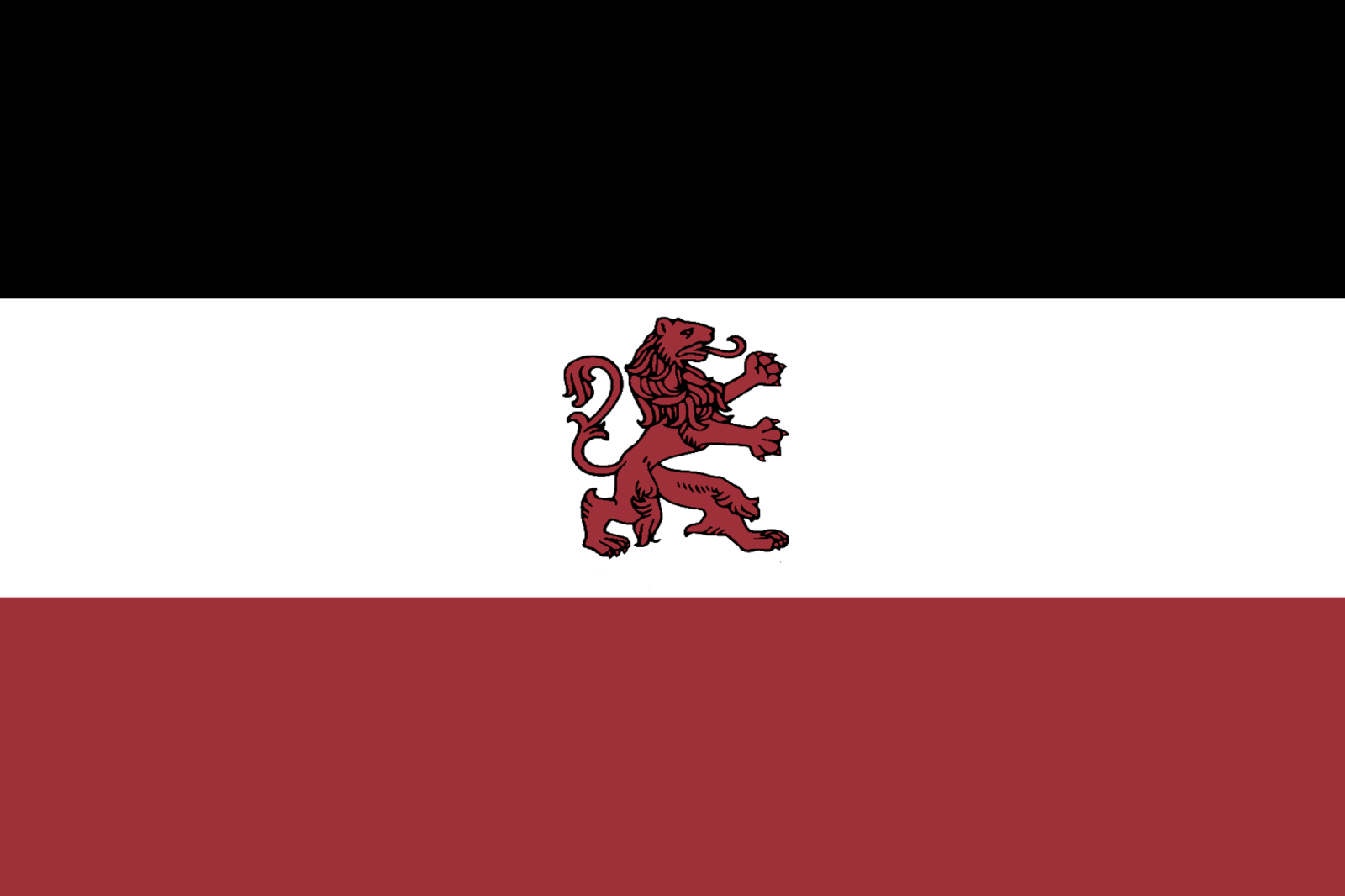
Friday Flag - Kurland
With the victory of the Central Powers in the Great War the German Empire established the new country of Kurland. This German puppet included the cities of Riga in the north to Brest-Litovsk in the south. The islands of Ösel and Dagö.
Inspiration for this flag came from the Atlas of World War I by Martin Gilbert (ISBN 0-19-521077-8). On page 46 was a map of 'German War Aims In Eastern Europe 1914-1918' which showed Kurland, a tiny landlocked Poland, and Ukrainian People's Republic.
The lion rampant is from the coat of arms of Courland. The colors are from the German and Latvian flags.
24 September 2015
Chilean-American War
The ascendancy of Chile after the War of the Pacific also lead to an increase in tensions between Chile and the United States. The 1885 Panama Crisis was one example of this tension. During the Chilean Civil War of 1891 the Itata incident saw the US seizing a ship carrying weapons to the Congressist faction in the conflict. The US was attempting to increase its influence in Chile by supporting President José Manuel Balmaceda.
Balmaceda lost the war to the Congressist faction. A month after the war was over the USS Baltimore arrived in the Chilean port of Valparaiso. On 16 October 1891 outside a saloon in Valparaiso an American sailor spit on a picture of a Chilean hero. In the resulting riot two US sailors were killed and over a dozen were injured. Many of the sailors involved were arrested by the local authorities. The new Chilean government, already upset with US actions during the civil war, rejected all of America's protests.
Secretary of State James G. Blaine had recently died of the chronic illnesses he suffered from. Without his advice President Harrison continued his bellicose rhetoric against Chile. On 11 December 1891 the Chilean response to Harrison arrived. By the afternoon President Harrison was asking Congress for a declaration of war against Chile. On 18 December 1891 The US Congress vote was 292 to 21 in the house and 39 to 35 in the Senate as a Joint Resolution.
The US military was unprepared for a a war with Chile. Construction of new ships and transports began while volunteers were being trained. By mid-April 1892 a force was ready to be deployed. 12 August 1892 saw the city of Iquique occupied by over 5,000 American troops.
During the months after the Declaration of War, Chile began to move its own forces to the northern portion of the country to counter any American invasion. While spread out over a large area, 40,000 Chilean troops were available, many of them battle-hardened during the civil war. While the Americans had better equipment they had long supply lines and were outnumbered by a foe who was fighting for their homes.
The US Navy was able to dominate the local waters. Only small naval encounters played out with the Chilean Navy resorting more to commerce raids on American commercial vessels. The blockade of Iquique and other northern ports was secure.
However, on 21 September 1892 a large-scale operation against the occupied territories was successful. Over 1,000 US soldiers died, most of the others were wounded and/or captured. It was a major disaster with only 413 escaping by sea. While America held the sea now Chile held 2,600 prisoners of war. More troops and ship were being produced in the United States and a larger, more powerful relief force would soon be ready.
The disaster in Chile spelled defeat for Harrison at the ballot box in November. Grover Cleveland won the election and had to plan how he would handle the war.
In late January 1893 the first 10,000 soldiers of a 100,000 force arrived in Peru as a staging area. The number increased to 25,000 by March 1893. Disputes between the US Army and US Navy as well as supplying the troops were problems. A planned two-pronged attack on Iquique and Coyhaique province were planned. Future arrives would reinforce which ever front needed it.
President Cleveland took office on 4 March 1893 just a week before the planned offensive. The President put the offensive on the back burner and opened diplomatic channels with Chile. He felt that enough people had suffered and died over a bar fight. The public backlash was high against Cleveland with unrelenting assaults by the press on a daily basis. The blockade of Chile was kept in place during negotiations. By June he submitted a treaty to the Senate. The treaty would see to the release of all prisoners, including the arrested crew members of the Baltimore, and the US would pay $200,000 in gold for damages to Iquique and from the blockade. The treaty only received 33 of the 59 votes it needed. They country was at war with a Commander-in-Chief who didn't want the war and a Senate that didn't want to end it.
Disease struck the military camps in Peru during August so any military operations would have to be delayed. During the three worst months of the outbreak over 3,800 Americans died. This delay did allow President Cleveland to try to acquire Easter Island from Chile in order to sweeten the deal for the Senate. By having the reparations be considered a purchase it might have a chance of passing.
November 1893 public pressure in the United States was forcing Congress' hand regarding the war. Despite the Democratic majority in the House a call was made to begin impeachment proceedings against the President for failing to carry out his duties as Commander-in-Chief, that failure leading to the loss of thousands of men to malaria and other tropical diseases as thousands of others suffered in prison camps.
On 15 December 1893 the President finally broke under the pressure. He resigned his office and Adlai Stevenson I was sworn in as the new President. Stevenson quickly organized a new campaign on Chile. Heavy fighting over the next four months on three fronts forced Chile to surrender on 14 May 1894. Five thousand additional Americans died, over 10,000 Chilean troops and thousands of civilians due to indirect fire, lack of supplies, and disease.
President Stevenson
The United States seized Easter Island and claimed $250,000 in reparations from Chile. Most of the money would never be paid as on June 3, 1884 Peru and Bolivia both declared war on Chile.
Grover Cleveland is actually one of my favorite presidents so I hope I didn't make him seem too much of a wuss in this alternate history. Perhaps he would have had no problem continuing a silly war since Britain did have some influence in Chile at the time... not sure if they had as much after the Chilean Civil War of 1891.
1) The Baltimore Crisis
2) United States intervention in Chile
3) Baltimore Affair
4) Adlai Stevenson
Balmaceda lost the war to the Congressist faction. A month after the war was over the USS Baltimore arrived in the Chilean port of Valparaiso. On 16 October 1891 outside a saloon in Valparaiso an American sailor spit on a picture of a Chilean hero. In the resulting riot two US sailors were killed and over a dozen were injured. Many of the sailors involved were arrested by the local authorities. The new Chilean government, already upset with US actions during the civil war, rejected all of America's protests.
Secretary of State James G. Blaine had recently died of the chronic illnesses he suffered from. Without his advice President Harrison continued his bellicose rhetoric against Chile. On 11 December 1891 the Chilean response to Harrison arrived. By the afternoon President Harrison was asking Congress for a declaration of war against Chile. On 18 December 1891 The US Congress vote was 292 to 21 in the house and 39 to 35 in the Senate as a Joint Resolution.
The US military was unprepared for a a war with Chile. Construction of new ships and transports began while volunteers were being trained. By mid-April 1892 a force was ready to be deployed. 12 August 1892 saw the city of Iquique occupied by over 5,000 American troops.
During the months after the Declaration of War, Chile began to move its own forces to the northern portion of the country to counter any American invasion. While spread out over a large area, 40,000 Chilean troops were available, many of them battle-hardened during the civil war. While the Americans had better equipment they had long supply lines and were outnumbered by a foe who was fighting for their homes.
The US Navy was able to dominate the local waters. Only small naval encounters played out with the Chilean Navy resorting more to commerce raids on American commercial vessels. The blockade of Iquique and other northern ports was secure.
However, on 21 September 1892 a large-scale operation against the occupied territories was successful. Over 1,000 US soldiers died, most of the others were wounded and/or captured. It was a major disaster with only 413 escaping by sea. While America held the sea now Chile held 2,600 prisoners of war. More troops and ship were being produced in the United States and a larger, more powerful relief force would soon be ready.
The disaster in Chile spelled defeat for Harrison at the ballot box in November. Grover Cleveland won the election and had to plan how he would handle the war.
In late January 1893 the first 10,000 soldiers of a 100,000 force arrived in Peru as a staging area. The number increased to 25,000 by March 1893. Disputes between the US Army and US Navy as well as supplying the troops were problems. A planned two-pronged attack on Iquique and Coyhaique province were planned. Future arrives would reinforce which ever front needed it.
President Cleveland took office on 4 March 1893 just a week before the planned offensive. The President put the offensive on the back burner and opened diplomatic channels with Chile. He felt that enough people had suffered and died over a bar fight. The public backlash was high against Cleveland with unrelenting assaults by the press on a daily basis. The blockade of Chile was kept in place during negotiations. By June he submitted a treaty to the Senate. The treaty would see to the release of all prisoners, including the arrested crew members of the Baltimore, and the US would pay $200,000 in gold for damages to Iquique and from the blockade. The treaty only received 33 of the 59 votes it needed. They country was at war with a Commander-in-Chief who didn't want the war and a Senate that didn't want to end it.
Disease struck the military camps in Peru during August so any military operations would have to be delayed. During the three worst months of the outbreak over 3,800 Americans died. This delay did allow President Cleveland to try to acquire Easter Island from Chile in order to sweeten the deal for the Senate. By having the reparations be considered a purchase it might have a chance of passing.
November 1893 public pressure in the United States was forcing Congress' hand regarding the war. Despite the Democratic majority in the House a call was made to begin impeachment proceedings against the President for failing to carry out his duties as Commander-in-Chief, that failure leading to the loss of thousands of men to malaria and other tropical diseases as thousands of others suffered in prison camps.
On 15 December 1893 the President finally broke under the pressure. He resigned his office and Adlai Stevenson I was sworn in as the new President. Stevenson quickly organized a new campaign on Chile. Heavy fighting over the next four months on three fronts forced Chile to surrender on 14 May 1894. Five thousand additional Americans died, over 10,000 Chilean troops and thousands of civilians due to indirect fire, lack of supplies, and disease.
The United States seized Easter Island and claimed $250,000 in reparations from Chile. Most of the money would never be paid as on June 3, 1884 Peru and Bolivia both declared war on Chile.
Grover Cleveland is actually one of my favorite presidents so I hope I didn't make him seem too much of a wuss in this alternate history. Perhaps he would have had no problem continuing a silly war since Britain did have some influence in Chile at the time... not sure if they had as much after the Chilean Civil War of 1891.
1) The Baltimore Crisis
2) United States intervention in Chile
3) Baltimore Affair
4) Adlai Stevenson
11 September 2015
Friday Flag - Duchy of Djibouti
In 1937 the Duchy of Djibouti was on of two colonies of the Królestwo Zachodnim Afganistanie that gained independence. The KZA's naval power was almost non-existent and the regular military conflicts with China and rebel hunting in the Russian Empire took nearly all of the nation's focus. It was felt that releasing the colonies from the Kingdom would allow them to better develop on their own.
The odd mix of politics and religion from the Królestwo Zachodnim Afganistanie carried over to the Duchy of Djibouti. Duke Cumar Grabowski took over as head from his father, Duke Stanislaw Grabowski. Prime Minister Xasan Aref Geelle controlled many day-to-day operations as the new country made a step towards becoming a constitutional monarchy. During the original colony's founding a large portion of southern Ethiopia was conquered and added to the Duchy.
A war between Djibouti and Ethiopia form 1940 to 1942 helped solidify the new nation and in the end brought Djibouti and Ethiopia on a road to lasting peace. As part of the terms of the Djibouti victory in the conflict, Prince Ismaaciil Grabowski would marry Princess Tsehai Haile Selasasie of Ethiopia. She was the youngest daughter of the Ethiopian emperor.
07 September 2015
Money Monday #6 - US Territorial Notes
With increasing tensions and threat of war with the Empire of Japan, the United States was determined to keep its money out of enemy hands if its territories were invaded. This idea eventually evolved into the 'Blue Back,' a territorial currency for use during the time of crisis. The first notes were issued in fall of 1941 and would be in circulation until 1948 (other than the Kamchatka-Chukotka & Philippines notes which were withdrawn after the 1942 invasion).
Each note had a letter designation for the territory it originated. If one of these territories fell to enemy forces the related money would automatically become contraband and have no value.
A: Hawaii
B: Alaska
C: Kamchatka-Chukotka
D: Philippines
E: Guam and other Pacific possessions
Over $580 million of territorial notes were printed. Various denominations and designations made up this total, mostly for Hawaii.
By the 1980s surviving 'Blue Backs' were worth quite a bit to collectors, especially the 'C' series.
Inspiration for this post came form the OTL Hawaii overprint notes issued during World War II.
Subscribe to:
Posts (Atom)