Showing posts with label Money Monday. Show all posts
07 September 2015
Money Monday #6 - US Territorial Notes
With increasing tensions and threat of war with the Empire of Japan, the United States was determined to keep its money out of enemy hands if its territories were invaded. This idea eventually evolved into the 'Blue Back,' a territorial currency for use during the time of crisis. The first notes were issued in fall of 1941 and would be in circulation until 1948 (other than the Kamchatka-Chukotka & Philippines notes which were withdrawn after the 1942 invasion).
Each note had a letter designation for the territory it originated. If one of these territories fell to enemy forces the related money would automatically become contraband and have no value.
A: Hawaii
B: Alaska
C: Kamchatka-Chukotka
D: Philippines
E: Guam and other Pacific possessions
Over $580 million of territorial notes were printed. Various denominations and designations made up this total, mostly for Hawaii.
By the 1980s surviving 'Blue Backs' were worth quite a bit to collectors, especially the 'C' series.
Inspiration for this post came form the OTL Hawaii overprint notes issued during World War II.
26 January 2015
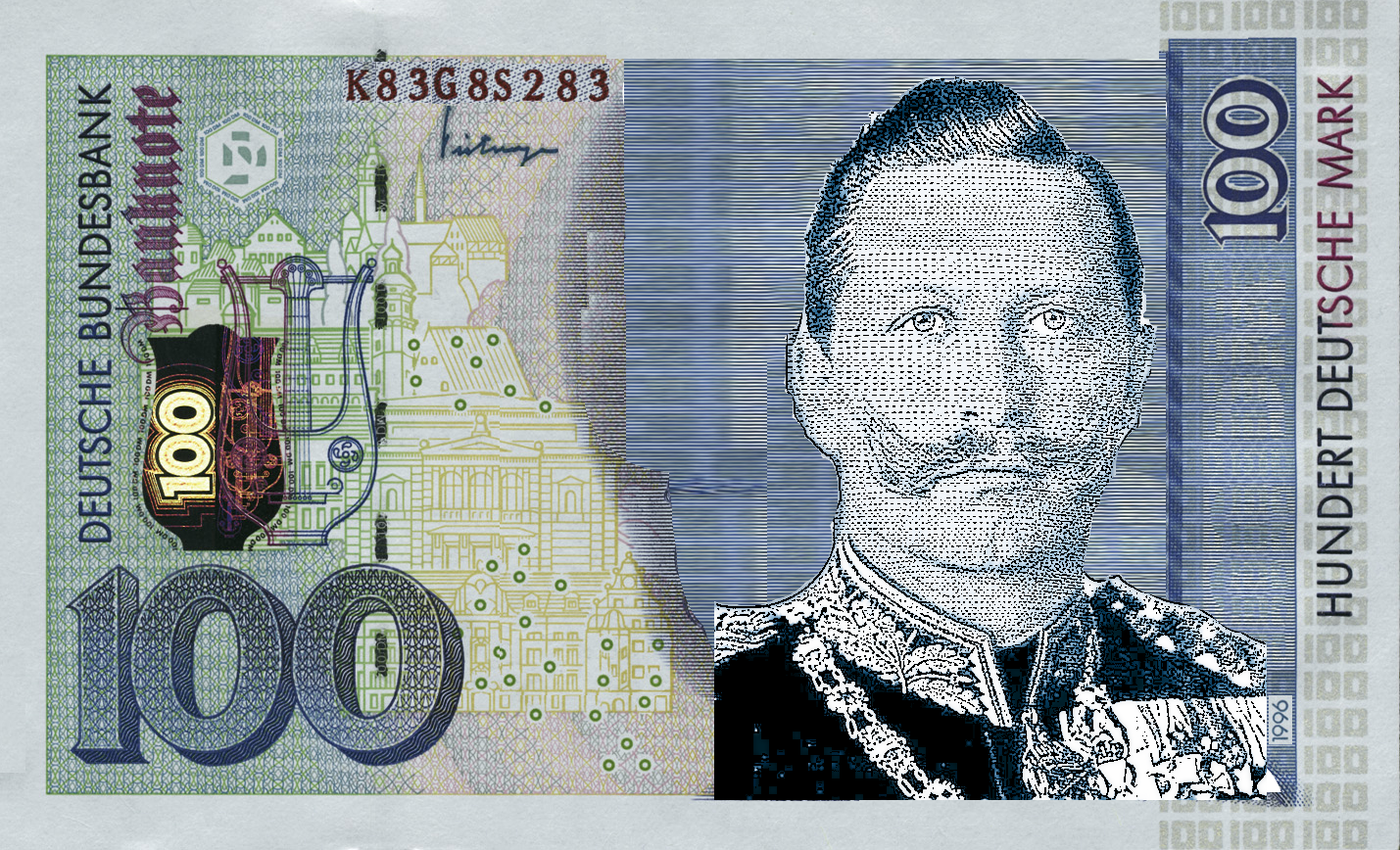
Money Monday #5 - 100 Mark Note
After victory of the Central Powers in the Great War Germany grows in power an influence across Europe, and the world. With the formation of the Confederation of Europe in the 1970s Germany was able to fortify itself as the most powerful economy in Europe. The strength and relative stability of the European economy makes the Mark one of the three most popular reserve currencies (The US Dollar and British Pound being the other two).
In the 1990s a redesign of the German Mark put Kaiser Wilhelm II on the 100 Mark note.
By 2015 the Mark began slipping further behind the dollar and pound as a general economic downturn and ongoing war in the Middle-East stagnates the European economy.
21 July 2014
Money Monday #4 - Certificado de Mercadoria (1970)
After the devastation of the Third World War the northern hemisphere was in ruins and the global weather patterns had shifted. The global economy suffered a catastrophic collapse leaving the surviving nations in chaos. Brazil made major changes in an attempt to avoid its own collapse. Surviving elements of the United States Navy would regularly use Brazilian ports in the years after the war. Since most currencies had collapsed the Americans had to pay for Brazilian help by helping their hosts maintain order.
As the turmoil began to slowly decline there was need of a stable currency to boost the sluggish economy. The Brazilain Real was experiencing extreme inflation and a loss of confidence. Local communities attempted to create their own currencies, some fiat, others based off labor. One of the more successful ones was the Certificado de Mercadoria (CM).
The CM was backed by the value of commodities that were supposed to be held in warehouses near major population centers. The certificates could be exchanged for the commodities listed on them at any time from these warehouses. This gave the certificates value and helped to counter the affects of inflation on the other currencies.
Every four to eight months a new series of certificates was issued. The new issue would have different exchange rates for commodities and some of the items listed on prior certificates would be removed while others added depending on supply. When a new issue was made older certificates were still good. This would lead to some confusion in exchanges but nobody wanted a currency that was only good for less than a year.
The Certificado de Mercadoria pictured above is from the second issuance of 1970.
The CM program was wrought with corruption, shortages of commodities, and other problems. However, it was still the most successful currency during in Brazil during the aftermath of the war. The last series for the CM was issued in 1981 and all outstanding certificates had to be redeemed by 1985 after the economy of South America recovered to a point where more traditional monies would function.
The text on the certificate reads: This Certificate of Merchandise allows access of commodities from the São Paulo storage facility as listed below. The exchange rate for this series (1970B) is based off ten-thousand (10,000) units.
Wheat 7,600 kg
Rice 7,250 kg
Sugar 2,000 kg
Coffee 120 kg
Corn 8,200 kg
Cotton 450 kg
Cement 17,000 kg
Copper 150 kg
Iron 8,000 kg
Aluminum 120 kg
Wool 80 kg
Peanuts 375 kg
This particular 1,000 CM certificate was exchanged in São Paulo during July 1974 by a construction company for 1,700 kg of cement.
The inspiration for this certificate comes from the Exeter Constant. Some information on that can be found at The History of Local Currency and in an article at Mother Earth News, The Causes of Inflation and a Commodity-Based Currency.
I designed a more colorful note and created it for a post-WWIII Brazil that was attempting to survive the collapse of the global economy. I used bits of an old one silver dollar bill from the US, as well as a $1,000 and $100 bill for elements of this design. I also copied a portion of a Brazilian bill for the top logo. Some color changes and other tweaks completed the design.
05 May 2014
Money Monday #3: Katangese Franc coin 1981
In 1960 one franc from the breakaway territory of Katanga was worth about 2 cents USD. By the end of their war for independence the same franc was worth about half a cent. In 1980 the currency was revalued due to continuing inflation. The new franc was now worth 4 cents USD. While many of the higher value coins and bills got major redesigns for the new currency issuance the 1 franc coin kept a more traditional design, the only difference being it was slightly smaller than the 1960 one franc coin.
NOTES
1) Some info on the Katangese franc in the OTL @wikipedia
2) In this timeline Katanga was successful in gaining independence from the Congo.
07 April 2014
Money Monday #2 - 100 Wampum note from 1967
100 Wampum bill from the Canandaigua branch - Six Nations Treasury in 1967
After the execution of the ringleaders of the failed revolution in the American colonies the British Empire made changes in its dealings with the colonists. More and more attention of the King was spent on developing the new world. The British would dominate all of North America before too long.
The French decided to ignore the Americas and sold Louisiana to the British. They used the money and new goodwill with their rival to expand into India and Egypt.
The British began to use their military to conquer native lands, but instead of adding them directly to the empire and expanding white colonization they established principalities of natives to rule over the land under British supervision. The Native Americans were treated more like the natives of India in the OTL. Political and Economic development was controlled from London which would eventually reap great benefits from this massive free trade zone.
One of the native countries that grew close ties to the British Crown was the Six Nations of the Iroquois Confederation. Given their proximity to the original colonies and early adoption of a number of European technologies they grew to be a strong industrial center. With this strength and greater autonomy they would eventually develop their own currency. The British pound is still used for trade outside of the Six Nations, but inside the locals enjoy using their own money. By 2014 they have benefited more often than they have been hurt by the regional currency.
In the twentieth century the 100 Wampum bill features a portrait of Thayendanegea (aka Joseph Brant).
31 March 2014
Money Monday #1 - 100 Zlotych note from the KZA
This is a 100 Zlotych bill from the Kingdom of Western Afghanistan. The Polish nobles who rule over a large portion of central Asia in the late 19th and early 20th century created this new currency to facilitate commerce in their domains. Local tribes don't trust this new money, but the King promised it was backed by gold and a safe medium of exchange.
The general poverty of the Kingdom still makes barter the primary means of exchange for many. The currency is of use by businesses that use the nation's growing railroad lines to conduct trade within the KZA. Most international still uses the Russian ruble.
I created this image using images of old Afghan and Polish money. Some cutting, pasting, resizing, and coloring resulted in what you behold here today. The money of imaginary nations can be as interesting as their flags and maps of their territories. It might also be good way for me to begin to explore other areas of alternate timelines besides who fought in which war and who conquered whom.
There are things more important in history than death, destruction, and domination; Science, invention, and prosperity.
Subscribe to:
Posts (Atom)