THE RED WAR PART ONE: ORIGINS
The disaster known today as The Red War had its origins in another conflict. That other conflict being the Russo-German War (1914 to 1917).
The Assassination
The catalyst for the start of the Russo-German War was the assassination of Archduke Francis Ferdinand, Inspector-General of the Austro-Hungarian Army and Heir to the Throne of the Empire. Ferdinand died in Sarajevo after being shot by a Serb national on 28 June 1914.
Calm Before the Storm
On the 5th of July the German Empire issued Austria-Hungary a "blank check" in dealing with Serbia. Austria-Hungary issued a harsh ultimatum to Serbia on the 23rd of July that was designed to be refused by the Serbs. That refusal came days later and it looked as if all of Europe could possibly be dragged into war.
28 July 1914 Austria-Hungary declares war on Serbia. Two days later Austria-Hungary mobilized its military. on the 31st Russia did the same. The Russian mobilization led to a flurry of diplomatic activity between Germany and France. Germany convinced France to stay neutral in the conflict since their agreement with the Russians was to come to Russia's aid if it was attacked first - but their mobilization against Austria-Hungary could be categorized as an offensive action releasing France of its obligations.
4 August 1914 the German Empire declares war on Russia to defend their Austrian allies.
The War
The Germans made quick gains into Russia in the first few months of the war. Their planned advance up the Baltic coast was delayed by the unexpectedly fast and powerful Russian attack on Austria-Hungary. The poor organization of the Austrian forces led to them being pushed back by the Russians and fighting a terrible winter war across the Carpathians from November 1914 to spring 1915. German plans were placed on hold so they could support their allies.
Serbia managed to hold out against the Austrian forces for over a year. They finally collapsed in October 1915 when Bulgaria joined the war on the side of Germany and aided in the conquest. This should have freed up a large force of Austrian troops to be used against Russia, but the terribly administrative skills of the Austrians made it clear that they would be lucky to be available for the Russian front by the spring of 1916.
Chief of the German General Staff von Moltke did not want to send a large force to decimate the Russian Carpathian armies and save Austria. "Saint Petersburg is to the north, bumbling fools to the south. We march North and to victory!" The summer of 1915 saw the German Baltic campaign against Russia.
The Baltic Campaign
At first German advances up along the Baltic coast met little resistance. Reports of major fortifications being constructed around Saint Petersburg including multiple rings of trenches were received. However without confirmation von Moltke was cautious.
Battle of Tannenberg
September 1915 the bulk of the German invasion force was entering Estonia when Russian General Alexander Samsonov struck. The bulk of Russian forces were not protecting St. Petersburg, but were in the Ukraine. When German supply lines were stretched Samsonov launched his attack through the weak German defensive screen and into Germany itself at the Tannenberg forest.
The Germany Navy controlled the Baltic and could get basic supplies to the German invasion force, but the supplies coming by land were needed for any serious offensive towards the Russian capital. Instead von Moltke sent half of his army back towards home in hopes of trapping the Russian army. The rest of the German invasion force would remain in the Baltic and consolidate its gains.
Back in Germany General Samsonov made some impressive gains and inflicted heavy casualties on the Germans. However in mid-October he came across the newly constructed German trenches and was stopped. Samsonov did not dig in himself knowing that a German army was approaching his rear; instead he fled south to used his forces against the Austrians, and hopefully commit the Germans to sending more forces south themselves.
Erich von Falkenhayn
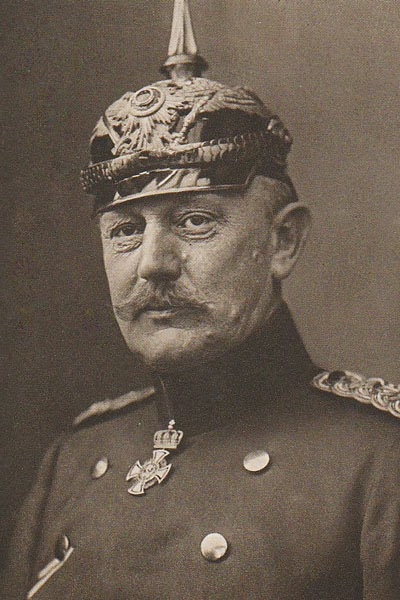
After the setback at Tannenberg, von Moltke began having major health problems. In November 1915 he was replaced by Erich von Falkenhayn. Over the winter Falkenhayn worked closely with his Austrian counterparts and helped to bring both Romania and the Ottoman Empire into the war in the spring.
In 1916 with the new front opened against Russia by the Ottoman Empire and Falkenhayn's decision to bail out Austria first before making the final push against Russia. Germany and her allies made great gains in the south but a number of things began to concern Falkenhayn. The Russians seemed to willing to trade land for time. There were also rumors about the capital being moved to Moscow, a much more difficult target.
The harsh Russian winters, the seemingly unlimited troops, and the drain on the German economy by the war were adding pressure to finish it quickly..... but the Russians were playing to drag it out as long as possible. It would would take a number of years before the Kaiser could dictate terms to his foe.
Enter, Lenin
The only way Germany could get a quick victory would be for the Russian people to rebel against their Tsar. It would not be possible unless some new element was added to Russia. That element was Vladimir Ilyich Lenin. The political chaos Lenin could unleash on Russia could help end the war in Germany's favor.
In October 1916 Lenin was smuggled into Russia. His revolutionary activities as well as a major German offensive in the spring of 1917 caused a collapse of the Tsar's government by June 1917. Not long after that would be the Russian Revolution and the beginning of The Red War.