Showing posts with label Book Review. Show all posts

06 September 2015

Book Review - CSS Appomattox

(image from Goodreads.com)


THE STORY
Once you get past the whole Confederate victory in the Civil War the story isn't bad.

Set a couple of decades after the Confederate States of America won their independence. The book starts out as a military fiction the crew of the airship Appomattox have a number of adventures. This leads them to becoming part of a military intelligence unit.

The USA agrees not to intervene in a war the German Empire starts with Spain to gain territory in the Caribbean. The CSA gives support to the Spanish Empire including military aid. The CSS Appomattox is a Confederate airship, under the command of Thomas Devareaux, is patrolling the Atlantic searching for German naval groups.

The Appomattox bloodies a Germany battle group, destroying some enemy airships that were flying cover. As the Confederate ship is being repaired much of the crew is drafted into intelligence operation in the Caribbean including infiltrating the jungle on occupied islands taken by the Germans. Devareux's personal life and traitors withing the Confederacy get drawn together in the backdrop of the war.

There is good pacing and a variety of action. The story itself is self-contained but has a number of loose ends and seems ready for a sequel.

THE CHARACTERS
Thomas Devareaux is of the standard heroic mold. He does have a romantic backstory with the daughter of a higher ranking officer. The bumps in that long-distance relationship add some chaos to Devereaux's life and have a further connection to the story. Most of the other crew members of the Appomattox are likable enough despite being Confederates.

FINAL THOUGHTS
Some of the technological innovations developed by the Confederates seemed a bit far-fetched, while airships are cool and all the CSS Appomattox seemed pretty advanced for the time. Technology-wise the CSA seemed to be keeping up with the USA. Given the difference in population and industry between the two nations the CSA would eventually fall behind relying on stealing technology from their northern neighbor. Then again the old Soviet Union was able to project a pretty good illusion about their technology and capabilities back in the day.

The battles with the German airships were entertaining. The portions of the story set in the jungles of occupied territories were interesting as well.

Overall the book was fun. I enjoyed the story and look forward to future chapters in series.

4 or of 5 stars.

NOTES
Author: Chris Stoesen
Print Length: 273 pages
Available for Kindle at Amazon.com

29 January 2015

Book Review - The Multiversity Guidebook


This review won't be of a regular alternate history book. Its for a comic book with details on a multitude of alternate Earths for the mainline DC Universe.

I haven't bought many comic books in the last decade. I sold off most of my collection a few years ago (for a tiny fraction of what I had paid for them) keeping the few that had stories I liked. New comics are too expensive and different titles are too connected story-wise requiring an even larger investments. The constant epic events and crossovers didn't help.

However yesterday I did rush out to the comic shop during lunch to buy a copy of The Multiversity Guidebook by DC Comics. I may not collect comics anymore, but I do like playing superhero role-playing games and I saw this book as a great set of ideas for expanding my RPG campaign.

WHAT'S IN IT?
The book contains part of the Multiversity storyline. It brings heroes and villains from various universes in the DC Multiverse together as part of a larger plot. The selling point for me were the map of the Map of the Multiverse and brief descriptions of 45 of the 52 alternate Earths that make up the DC Multiverse. While I would have liked more details on the various alternate Earths there was enough info for my gaming purposes.

The story portion of the book is broken into a couple parts - one has two very different Batmen teaming up to escape an army of robots created by alliance of a couple dozen Sivanas. Meanwhile, on an alternate Earth, Kamandi and his allies investigate a tomb on 'the Island of the God Watchers.' By the end of these short pieces the Batman from Earth-17 finds himself in the Hall of Heroes just as it is attacked by forces of the BIG BAD GUY.

MY THOUGHTS
The alternate Earths have only one or two short paragraph descriptions. Not too much information on divergence points, etc. But given the super-hero spin most of them are interesting in their own ways. If I start up a superhero RPG campaign in the near future I might try setting up campaigns on either Earth-17, Earth-20, or Earth-31.

Earth 17 diverged with a global nuclear war in 1963. It is now over 50 years later and the world's heroes are fighting to rebuild their planet and keep mutants at bay (and fight off Darkseid).

Earth 20 is a pulp-style world with Doc Fate and the Society of Super-Heroes. Given my love of old pulp stories this one would be a fun campaign setting, and the war it is having with Earth-40 creates many more opportunities for adventure.

Earth 31 suffered some terrible disaster in its past. The global sea levels have increased (I'm picking about 100 meters for my maps), and also suffered tsunamis and earthquakes which further changed the surface. Swashbuckling adventures and piracy appear to be the key here, and the image including a steampunk-looking Cyborg opens up other gaming possibilities.

I just hope this guidebook and the effort they've put into this whole Multiversity thing means that DC is finally going to stop messing with the history and structure of their multiverse for at least for a decade or two. All in all I'm happy with the guidebook. While I wanted more what was in it was good. 4 out 5 stars.

31 December 2014

Book Review - A Gray Tide In the East

(image from Amazon.com)


Book by Andrew J. Heller

THE STORY
The Kaiser decides not to appear as the aggressor in the upcoming war. At the last moment he scraps the Schlieffen plan and decides to focus on the Russian Empire first. At that point everything changes. The French come to Russia's aid, but they end up attacking Germany along a short and well fortified border - and they fail to break through.

The story then follows various point of view characters as they reveal and react to the events in this divergent World War. Not too much focus is given to the men in the field, but a good overview of the war is revealed. Not to spoil things too much, but the Germans do extraordinarily well. They still introduce some horrific weapons and make steady progress against the German Empire.

They only real problem I had was with how the Germans caught all the lucky breaks. It seems to me with the changed scenario some French or Russian officer would have pulled a fast one on the Germans and given them some setbacks.

A few minor powers take on different roles than in the OTL. Japan occupies French Indochina supposedly to help the French keep the peace... they end up staying and keeping the colony for themselves.

Rounding out the book are a couple of Afterword essays, Counterfactually Speaking and The War That Was and the War That Was Not. This is a way for the author to give some of his views and reasoning about his work. It includes footnotes and references making it a welcome addition to the book.

THE CHARACTERS
There were numerous characters involved in the story. I won't go into too much detail of them here since none of them were vital to the plot of the story. They all helped give the reader the information on the war itself, none of them were in a position to really change the outcome.

Adolf Hitler made a brief guest appearance.

FINAL THOUGHTS
I liked this book. The First World War is on of the areas I like reading alternate and real history about. While it could have used a few set backs for the Germans and an unexpected twist or two it did give me some of what I expect from an alternate history story. While character development is nice, not all stories need such a thing. Sometimes in alternate history the most important character is the new timeline itself.

Overall it was interested, it's relatively short length worked for it - another 200 pages would not have necessarily made the book better without major changes in the way the story was being told. Short and interesting is good, which is reflected in my rating; at the time I was also slugging my way through the last couple of books in Harry Turtledove's War That Came Early series and was getting a little tired of the limited viewpoint and overly long story which A Gray Tide in the East was a nice contrast to at the time.

4 out of 5 stars.

NOTES
Publisher: Strict Publishing International
Page Count: approx. 165
Genre: Alternate History
ISBN: 0857792873

02 August 2014

Book Review - Napoleon in America

(image from Amazon.com)

Napoleon in America was written by Shannon Selin

THE STORY
The story was great. Jean Lafitte rescues Napoleon from Saint Helena and takes him to New Orleans in the United States. After recovering from his exile Napoleon tours the United States claiming a desire to live in peace. It is clear that he is less than honest in his claims. North America appears ripe with opportunities for the little dictator. Canada, Texas, the west, Europe, and even the United States itself could possibly become the object of his desires.

Once he determines his target, Napoleon gets to work at attempting to accomplish his goal. There are plenty of French exiles, American mercenaries, and people with questionable motives available for a new army. They are gathered together and thankfully some time is spent training the mixed force. There are still plenty of surprises during the campaign; North America is not Europe, there are plenty of things to catch Napoleon off guard.

The ending was satisfactory, and the outcome was in question until the end. While I felt the possibility of a sequel the story was self contained and doesn't need a sequel to be complete.

THE CHARACTERS
Well, the most important character is Napoleon himself. A large supporting cast made up of a great many historical figures helps round things out.

In the back of the book is a summary of the cast of characters, at least the ones that were based off actual historical figures. And there are a lot of them! The Napoleonic era was never one of my strong points so I didn't recognize many of the characters but knowledge of them all wasn't necessary to enjoy the story.

FINAL THOUGHTS
This is an excellent book. The only real complaint I had was that things seemed to flash back to Europe a little too often. I was anxious to see what Napoleon would do. I do realize the European reaction to Napoleon's escape is an important part of the story, but a little more insight into what the American government's reaction to Napoleon's betrayal of their hospitality and protection would have been nice.

Despite my limited knowledge of the source material the book was obviously well researched. When the battles finally took place they were well detailed and not glossed over. I've tried to avoid spoilers. Napoleon does raise an army in America but I left out the target. While he may or may not have been successful there is a good end point for the story and the reader isn't left disappointed.

Anyone who likes alternate history should find something to enjoy in this story. Unless you just have a general dislike of the Napoleonic era there should be something of value for you to find within.
One final note - I noticed the use of &c. for etc. I had never seen that before, and honestly thought it was a glitch in the Kindle version of the book at first. However that is a legitimate, but uncommon, way to abbreviate etcetera. Now I plan on springing that on my writing group the next time I have to use etc. in a short story.

4 out of 5 stars.

NOTES
Publisher: Dry Wall Puublishing
Page Count: 312
Genre: Alternate History
ISBN: 978-0992127503

17 June 2014

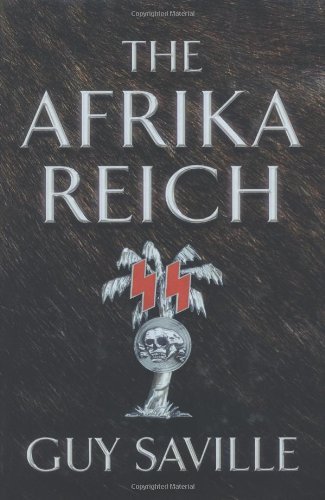
Book Review - Afrika Reich

(image from Amazon.com)

I really liked Afrika Reich. It had a few problems, but none that destroyed it for me…. But one problem came pretty close.

THE STORY
Dunkirk was a total disaster for the British. Most of their troops were killed or captured. Winston Churchill quickly lost his still new position as Prime Minster and the UK negotiated a peace with the Third Reich. Without a western front to worry about the Germans then turned their full attention to the Soviets.

The story starts in 1952. A large portion of Africa is under Nazi domination. They have spent a decade remolding it based off their twisted imaginations. Burton Cole is a mercenary who decides to do one last mission to assassinate his old nemesis, Hochburg. Hochburg controls the Afrika Reich and has plans to move against some additional African territory.

Things quickly turn south for the team and they are scattered across Africa fleeing a variety of German troops, police, and spies. The British government, who they think they are working for, refuses to aid them and closes the Sudanese border to keep them from escaping Reich territory. Now with no friends, no supplies, and a horde of Nazis pursuing them they have non-stop action in their attempt to escape the continent.

There is also a sub-plot that ties into the main story involving an African woman named Neliah. She works with the Portuguese military in the portion of Angola still held by Portugal. She is not taken seriously as a warrior by the white men so she is out to prove herself. Her determination and skill helps to uncover a dangerous plot that is unfolding.

THE CHARACTERS
Burton Cole: Pretty standard set up. A mercenary who has given up the life to start a farm back home. He wants to marry his sweetheart who is pregnant with his child. Money is tight and things will be difficult, but the future looks bright. Then he decides to take that one last job into the heart of the Afrika Reich. The leader of Nazi Africa, Hochburg, happens to be the man Cole blames for the death of his mother. In addition there is a large sum of money involved, enough to be set for life. Of course giving into his greed and thirst for vengeance mean things won’t be as simple as explained by his contact.

Patrick: A close friend of Burton's most of the time. They served on many mercenary missions in Africa back in the early years of Nazi occupation. His main goal is to get back to the United States to be reunited with his daughter. He suffers a stigma from being an American, they are seen as inherently cowardly since they did not get involved in the Second World War. He also has his lucky pipe.

Hochburg: Burton’s arch-nemesis and the reason he agreed to go to Africa one last time. Hochburg is your typical Hollywood Nazi, totally evil no redeeming qualities. He does have a background that ties in with Burton’s and the two men actually both seem equally stubborn.

Neliah: An African woman in Portuguese Angola. She leads a small group of warrior women and wants to avenge her dead parents who were killed when the Nazis conquered southern Angola. She has to deal with being looked down upon because of her race and gender so eventually goes off to fight on her own as the Portuguese flee to protect the capital.

FINAL THOUGHTS
Despite a few of the problems with the story it read like an old pulp adventure. I also appreciate an alternate outcome World War II where the action doesn’t focus on Europe or North America. I’ve read Soldier of Fortune on-again-off-again over the years as well has reading most of the memoirs of Mike Hoare, so reading about these mercenaries fighting their way across Africa brought back some additional memories.

Still, Nazi Germany clearing out all of the natives in the Congo in just a decade? They would have focused their limited man-power on Eastern Europe to clear out the natives there to allow for German expansion – that would have left limited resources for a major project covering over half the second largest continent in the world. The mountains and jungles are quite a bit different than the plains of Eastern Europe. It is impossible for the situation scenario in the book to have happened the way it did.

Also, I know there are really tough people out there. Still, some of the punishment that Cole went through on a regular basis was starting to border on unbelievable. But then again any movie with Schwarzenegger or Stallone has the same problem so it can be overlooked given the style of the story.

Overall I give this one 4 out of 5 stars given my bias. If you go in ready to accept a couple of improbable things and focus on the action it should be enjoyable.

NOTES
Publisher: Hodder & Stoughton
Page Count: 433
Genre: Alternate History
ISBN: 978-1-444-71064-9

14 May 2014

Book Review - GURPS Alternate Earths 2

(image from Amazon.com)

This is another great GURPS book. A sequel to GURPS Alternate Earths. It introduces six new timelines and lots of other crunchy bits.

NEW WORLDS
Cornwallis
The British keep the French from interfering with the American Revolution. The revolution fails. In the early 19th century Tecumseh forms a confederation that is recognized as a subject nation of the Empire. Changes continue over the decades.

By 1983 the British Empire spans the Cape Colony, St. Louis (this timeline's name for Australia), and large portions of North America, along with scattered islands. They are by far the most powerful nation on Earth. The Russian Empire is doing well for itself as well, having kept Alaska and adding Manchuria and Japan to its territories.

All is not well. Without a successful American Revolution representative government never spread. The various empires and kingdoms spend much time crushing revolutions and their technology is a little behind the OTL in 1983.

Ming-3
The Chinese treasure fleets are never disbanded. The Chinese continue to explore and expand their influence across the seas. Violent encounters with the Portuguese required a demonstration of imperial power. By 1519 one of their fleets arrives in Lisbon, Portugal to deliver an ultimatum.

Growth of the Chinese territory continues. By 1859 well over half the world is controlled by them. All of eastern Asia, all of Australia, eastern and southern Africa, most of Europe (except for Russia), Central America as well as the west coasts of both North and South America.

Midgard
In 860 the Vikings successfully raid Constantinople. The vast wealth and new technologies they gain allow them to continue expanding their culture across the world. Numerous Viking nations are established as they have the resources to expand and develop colonies in Vinland.

The spread of knowledge of the new world allows others to cross the Atlantic. By the early 12th century Moslems settle in what in our world is Cuba. Within a few hundred years they add much of northern South America to a new Caliphate.

The Mongol invasion of Viking lands in 1237 are not as successful as in the OTL. In fact by the late 14th century the Golden Horde is finally destroyed.

By 1412 the world is a much different place than it is here. A very interesting world to adventure in.

Caliph
Technological advancement begins earlier in the Middle-East. By the ninth and tenth centuries the Abbasid caliphs have a scientific revolution. Oil replaces coal as a source of power and technology really begins to advance.

By the 13th century Islam is dominating much of the world. A global war between various states is fought in the early 14th century. All throughout this time technological progress marches on. Before the Spanish discovered the Americas in our timeline this one had a man landing on the moon!

Earth develops its first interstellar colony by 1568 and will contact alien life less than a century after that. By 1683 technology has advanced so far a visitor from our world would believe they had been transported to the far future.

Aeolus
William of Orange fails to take the English throne in 1688. The world continues to be controlled by squabbling monarchs. The concepts of liberty and democracy are never popularized until some writings in 1906.

In 1939 a republican uprising in Austria overthrows the Habsburgs (they flee to take control of Russia) and numerous small republics form. They form the Republican Alliance and are at war with Habsburg Russia. The weird bit is that the Republicans then invent combat aircraft, skipping propeller driven craft and going straight to primitive jets.

Centrum
An even more successful domination of the world by England. By 1902 there is an atomic war and much of the royal family is killed. Succession wars and rebellions send the world into chaos.

After the chaos died down a group called Centrum begins to restore order to the shattered world. With the discover of the ability to travel to alternate worlds they expand their mandate to bring order to other worlds as well.

In 2007 they are involved in what they call the Dimension War with a group calling itself Infinity. This world is a look a the home of the 'bad guys' from the Infinite Worlds setting in GURPS Time Travel. It's nice to have more details on the world they came from.

FINAL THOUGHTS
Another great GURPS supplement. I only wish that there was an Alternate Earths 3 (and 4 and 5 etc.). Some creative worlds with some details for basing a role-playing game around. Each of the Earths has notes on integrating and crossing over other GURPS products to expand and customize the campaigns.

Of course because of my bias in my love of RPGs and having run a GURPS alternate world campaign for three years I have to give this book 5 out of 5 stars.

If you ran an alternate world RPG campaign and used this book in the game please leave some details about it in the comments section. Thanks!

NOTES
GURPS Alternate Earths 2 was published by Steve Jackson Games
Page Count: 128
Authors: Kenneth Hite, Craig Neumeier, and Michael S. Schiffer
Year Published: 1999
ISBN: 1-55634-399-X

05 March 2014

Book Review - The Divide

(image from Amazon.com)

William Overgard's The Divide is an alternate history tale involving a world where the Axis Powers won the Second World War. From what I could tell history diverged at a couple points, one being the election of an isolationist President in the United States and the second being a change in Germany's tactics that allowed them a quick victory over Britain.

THE STORY
It is 1976. Two-hundred years since the Declaration of Independence and thirty years since the United States surrendered to the Axis. The elderly Hitler and Tojo plan a historic meeting in the center of America at a place they call the Divide. America has been a peaceful place for a number of years, no real uprisings, citizens being willing slaves to their German and Japanese masters. All that is about to change.

A number of people get involved in setting the stage for a new American Revolution. It starts with the bizarre assassination of a Japanese general on the Fourth of July. The story then jumps between various characters - the trio of freedom fighters and their interactions with other rebel elements, an SS officer tasked with destroying the resistance, and other people whose lives are touched by the ongoing events.

Pieces start to fall in place and all of the threads lead to the meeting of the two rulers at the Divide. There are plenty of set-backs and a few twists and turns along the way.

Overgard's style is interesting. There is a tendency to introduce new information and then spend a few pages telling the back-story of that new information, usually in the form of flashbacks. While this works in most cases, there were a couple of times I wished he would shorten some of the flashbacks and keep going with the events in the 'present'.

THE CHARACTERS
The Old Man (Wayne Stubbs) is the main character of the story. He has a checkered past involving accidentally injuring a prostitute, indirectly causing his wife to commit suicide, and then wounding another prostitute in an attempt to kill her while suffering the rage and despair following his wife's death. He then fled to Canada and eventually made his way back after America fell to the Axis. Not the most heroic of backgrounds but he now feels he has to make up for the past by saving the country's future.

The Cowboy (Cooper): This young man was raised by The Old Man. He was raised to be a hero and to be an inspiration for others in the coming revolution. He plays his role well but gets caught up in his first real encounters with women (he and The Old Man lived a very isolated and hobo-like lifestyle).

Claus Dieter is the antagonist from the SS. He is on the trail of the heroes after the July 4th assassination. He is an evil and deceitful man who, while smart, is usually in over his head. He tries to destroy the resistance while keeping his superiors from getting rid of him for any failures.

In addition there are numerous other characters, an Amerind girl, a Jewish woman who is putting the finishing touches on her father's bomb, and many others. Most of the characters are interesting and the liberal use of flashbacks in the novel gives us all the information we need about them.

FINAL ANALYSIS
A great story overall. I have mentioned the sometimes annoying use of flashbacks, but there were only a couple of places that this really bothered me. The ending, while it wrapped up the main story, did not reveal the eventual results of the new Revolution. In fact the last page was about Hitler's daughter being pregnant. I'm not sure if this was to set up a sequel or just to establish that history keeps chugging along, even after some really historic events take place.

As with life, there are not happy endings, just another day and new challenges following the last.

I gave this book 3 out 5 stars when I rated it on Goodreads. It's better than a three but not quite a 4. I was in a phase of not inflating my ratings with too many 4 and 5 stars.

PUBLISHER: Jove Publications, Inc.; copyright 1980 by William Overgard
GENRE: Alternate History
PAGE COUNT: 244
ISBN: 0-515-05492-5

01 July 2013

Review - We Could Do Worse

Life's gotten a bit busy! It's been over a week since my last update. Sorry about that. Here's a brief book review until I can finish a couple of meatier posts I'm working on:
(image from Amazon.com)

Here is a collection of alternate histories that includes some big names. Brief descriptions follow... very brief since I wanted to avoid spoilers.

1) A Massachusetts Yankee in King Arthur's Court: by Harry Turtledove. JFK is sent back through time and space to Camelot. He meets and has a fling with Queen Guinevere. No real point to the story. Just makes JFK and the Queen look like jerks. Just involves time travel - not really alternate history.

2) Ike and the Mike: by Howard Waldrop. Instead of becoming generals Eisenhower and Patton are jazz musicians! Good story; not very believable but its not bad.

3) Looking for the Fountain: by Robert Silverberg. The story of one of the survivors of Ponce de León's expedition to search for the Fountain of Youth. A really good story about a lost civilization they discovered instead. Great idea - but there is no follow up, no indication of how history was altered.

4) The Return of William Proxmire: by Larry Niven. An interesting story of what happens to a man who travels back in time to change history and the consequences he suffers. Not one of those ironic Twilight Zone consequences, but a interesting take on what might happen to a time traveler.

5) The Arrival of Truth: by Kristine Kathryn Rusch. The best of the collection of this book. Tells a story from the point of view of a slave in the American south when a slave uprising begins. The most interesting characters in the entire anthology.

6) Goddard's People: by Allen Steele. In a world where America and the Third Reich are in a race involving rocketry. The Nazis want to create an ICBM and the US wants to create something to shoot it down. Interesting, but I'm not sure things would have turned out differently.

7) Over There: by Mike Resnick. I've read this one in other anthologies. Teddy Roosevelt assembles his Rough Riders to fight in the Great War. The old and new worlds collide in this fine story.

8) Bloodstained Ground: by Brian Thomsen. Failed novelist Sam Clemens vs. the legacy of newly deceased President George Armstrong Custer. One of the better stories in this anthology. Even if he failed as a novelist, Clemens would have excelled in whatever else he chose to do.

9) We Could Do Worse: by Gregory Benford. A short piece set in a world where McCarthy became president of the US.

Over all I'd give this book 3 stars. Maybe the low end of 3. While most anthologies end up netting out to about a 3 I had higher hopes for this one. Oh well, better luck next time.

23 May 2013

Book Review - Apacheria

(image from Amazon.com)


A brief review avoiding spoilers:

THE STORY
Naiche and Juh,father and son Apache help to unite his people in a war against the United States. Instead of fighting as an army on the open field he uses guerrilla tactics to show how helpless the occupying forces are. The financial drain on America grows and many Eastern states begin to question funding such an expensive war for such a small area. Eventually the United States gives up and Apacheria is born.

There were a few catches with the peace treaty. Mining of Apache land will continue for a few decades and a rail line will operate through Apacheria - all for royalties to be paid to the new nation. The Apache are now faced with running a new nation and attempting to maintain their old ways.

There are bumps along the way. If there weren't it wouldn't be much of a story. Inter-tribal alliances fray and outside pressures of the modernizing world have their effects on Apacheria. It will be up to Naiche's son, Juh to help his people navigate these challenges and help the land prosper.

They story ends with Apacheria attempting to adapt to the world during the Roaring '20s. Prohibition, gangsters, and Tommy guns herald a new and interesting age for the fledgling nation.

THE CHARACTERS
Plenty of interesting characters. A healthy does of real-world characters help to show how things have diverged. Presidents Taft, Teddy Roosevelt, and Wilson make appearances as do others such as Carrie Nation, Al Capone, and J. Edgar Hoover. Then there are the various Apache characters including Geronimo.

Juh is a good character. He lives in two worlds and has both his father's legacy and his homeland to protect. He is intelligent, brave, a good warrior, and is open to new ideas.

Geronimo is awesome too. He becomes the Apacheria ambassador to Washington, DC. He takes to that role well and is a good mentor to Juh.

CONCLUSION
Over at Goodreads I gave this book 4 out of 5 stars. Overall it was well done.

The only problem I had with it was how easily the United States gave up on trying to subdue/conquer the Apache. Sure the drain on money would be annoying but the blood that had been spilled and the perceived stain on America's honor would have it done a lot more to push the US to continue fighting until it could be victorious. Heck after the amount of blood and gold spent in the Civil War and the the money and tens of thousands of lives that would later be wasted in participating in 'The Great War' I don't see a few million dollars and a few hundred dead stopping America from charging in and getting revenge on the Apache.

Beyond that one complaint it was a very entertaining read.

VITAL STATS
*Author: Jake Page
*Publisher: Del Rey
*ISBN: 0-345-41411-X
*Pages: 342
*Point of Divergence: 1884

11 April 2013

Book Review - GURPS Alternate Earths

(image from Amazon.com)

This book covers a lot of territory. In addition to the detailed worlds there are notes on developing a campaign based on travel between alternate worlds.

NEW WORLDS

Dixie
An alternate world that diverges in 1856 with William Walker successfully conquering Nicaragua. This eventually leads to events that give the Confederacy victory in the American Civil War.

Reich-5
Axis powers win World War II. Diverged from real history in 1933 with the assassination of FDR. By the 1970s Nazi space exploitation is more advanced than anything we have in 2013. It is a dark nasty world, with the addition of more cybernetics it would make an interesting setting for a cyberpunk campaign.

Roma Aeterna
No exact divergence point is given for this world dominated by the Third Roman Empire. It is now 2631 AUC (AD 1878) and Rome dominates the Known World. I say the Known World because many portions of the globe are still covered by 'barbarian darkness'. Unlike many other alternate histories involving the Roman Empire I've seen this one has the technology of the Empire rather backwards and different. All things considered behind what we had in the real world in 1878. A sidebar on scientific advancement in this world telling of the problems they've had is given.

Shikaku-Mon
One of my favorite alternate histories. The son of Ferdinand and Isabella of Spain, survives to ascend to the throne. the Habsburgs never gain dominance over Spain. Changes begin to snowball. The Reformation takes a different course and Jesuits are successful in converting much of Japan.

By 2015 the world has four superpowers. The three nuclear powers are The Swedish Empire (controlling all of Scandinavia, the Baltic states, northern Germany, Poland, Greenland, and parts of what would be northern Canada, New England, and other parts of the north-east US). Next is Christian Japan (which controls India, Australia, southeast Asia, much of China, parts of northeast Asia and an enlarged Alaska). The Empire of Brazil is a slightly larger version of the Brazil of our world (and their government recently collapsed making it a large state where anarchy is practiced). The one non-nuclear world power is France. France is a world power not because of territory but because of their exploitation of space. They don't need nukes when their lunar mass drivers can destroy cities just as well.

Ezcalli
Carthage discovered the 'New World' in 508 BC. Over 2,300 years later the Mongol Khaganate dominates most of Eurasia, the Tenochca Empire dominates Central America as well as parts of North and South America. The Songhay Empire controls a chunk of north-west Africa.

Gernsback
This one technically would have diverged with the Big Bang. Science is capable of marvels seen in the old pulp magazines. The more obvious divergence is when Nikola Tesla marries the daughter of J.P. Morgan. By the 1960s the world is rapidly advancing in technology. New inventions are encouraged, the atom isn't feared, and the world appears to be heading towards Utopia. The World Science Council helps guide things along. Mad science and art deco architecture. Loads of fun.

FINAL THOUGHTS
Since I've run alternate Earth campaigns (including one with GURPS using the Shikaku-Mon world as the starting point for a three year campaign) I am a little biased about this book. It has a half-dozen well developed worlds with timelines and notes on cultural differences plus notes on bringing in elements form other GUPRS books into the setting. There are also many other short descriptions of other alternate worlds that follow a similar theme to the ones described here. It is an indispensable resource for an alternate world RPG in any system.

Given the vast utility I received from this book, even glancing at it on a regular basis in the present, I have to give it 5 out of 5 stars.

Perhaps some day I'll have to make a series of posts giving the highlights of that old GURPS Infinite Worlds campaign I ran. Could be interesting, what do you think?

NOTES
GURPS and this Alternate Earths sourcebook are published by Steve Jackson Games.

Page Count: 128
Authors: Kenneth Hite, Craig Neumeier, and Michael S. Schiffer
Year Published: 1999
ISBN: 1-55634-318-3

03 April 2013

Review - Warlords of Utopia

(image from Amazon.com)

WARLORDS OF UTOPIA


by Lance Parkin


THE STORY
The story of 1,000 alternate worlds dominated by an eternal Roman Empire go to war with 1,000 worlds where the Nazis won World War II. It doesn't get much more bad-ass than that. Written in the first person from the point of view of Marcus Americanius Scriptor. He describes how he recovered an item that allowed Roma I to travel to alternate Roman worlds and how the discovery of the Nazi dominated worlds led to war.

That's a lot of territory to cover in 180 pages. Throw in entities and mentions of an even bigger conflict (between the Great Houses and Faction Paradox) and the story becomes truly epic.

From an alternate history perspective there are only the occasional mentions of what some of the thousands of alternate worlds are like and how they diverged. The alternate technology of some of the worlds is interesting but at times unrealistic.

It would have been nice to learn a bit more about some of the other worlds. More descriptions of how they interconnect would also have been something I would have liked (they develop a rather haphazard way of mapping the Romes). Given the scope of the story I can understand why details were glossed over.

THE CHARACTERS
Marcus Americanius Scriptor is the main character. The book is written as his memoirs. He is not a nice person.

After murdering an old man for a device that would allow him to travel to alternate worlds he builds up a vast business empire revolving around cross-dimension travel. While there is nothing wrong with enriching himself and civilization with this item, he uses it to gather materials to blackmail political opponents. When one opponent to too noble and incorruptible Marcus just murder him.

Also, after page-after-page about hearing form Marcus about how Roma I was a perfect world and the Roman way of life is superior to everything he turns around and betrays his Emperor and starts a war that nearly led to the destruction of everything he held dear.

He is a selfish, narrow-minded, and disloyal man.

He does, however, have many heroic qualities. His strong will and vision help strengthen his family and does bring wealth through trade to many of the Roman worlds. He is also a great warrior and is able to quickly develop new tactics having to integrate new technologies and weapons into his plans.

He also has that single-minded stubbornness of the pulp heroes of old.

As with many books written from the first person point-of-view I found my self trying to read between the lines and figure out what might have really been going on. Anyone writing their memoirs, especially ones involving wartime, are bound to gloss over and change details that show them in an unfavorable light.

FINAL ANALYSIS
The story is well done. It covers a lot of ground and does it efficiently. Despite some of my complaints about the main character mentioned above he is not a bad one to be the viewpoint character. The first two-thirds of the book are solid. The last third - where the Romans and Nazis are at war - just does not seem believable. Of course what is believable in a story of nearly two-thousand alternate worlds at war? It was more of the swords vs. machine guns scenario. I can see times when the more basic weapons of the Romans would come in handy (and they did have some high-powered crossbows as well as catapults with ranges of a mile or more) but in a normal battle I'd bet on the automatic rifles.

The Nazis would also have adapted to the new type of warfare. They also would have made things much more costly for the Romans by using nuclear weapons on a much broader scale. The war would have lasted a century not the decade described.

I also wonder how the Romans, who have been at peace for centuries on many of their worlds, can be such disciplined and good warriors. Just seems a little odd to me.

I give it 3 out of 5 stars.

NOTES
Faction Paradox is an unofficial spin-off of the Doctor Who Universe. More information can be found at the Faction Paradox Wiki.
Related Posts Plugin for WordPress, Blogger...