03 May 2016
US Presidential Election 1964
In April 1961 a CIA backed operation to overthrow President Charles de Gaulle's government was successful. General Maurice Challe strengthened ties with the United States and pushed to make France an important member of NATO. In return for French cooperation the US began to send advisers and equipment to Algeria to aid France in its war there. The Soviet Union smuggled weapons to the Algerians and moved some of their own soldiers from the Muslim regions of the USSR to the combat zone. Algeria quickly became an important proxy war between East and West.
President Kennedy was forced to increase the assets sent to Algeria over the next few years. In 1962 Marines and Naval air assets took direct action in the conflict shortly followed by US Army ground forces. This was taking place as the President was also increasing commitments in Vietnam. The American people would not stomach two major foreign wars, so by 1964 the few advisers in Vietnam were withdrawn, leaving that country open for conquest by communist forces. Efforts were then re-doubled in Algeria. Rumblings of a return of the draft angered more Americans.
In 1964 nearly all of Algeria was occupied by Franco-American forces. However the Algerians would not surrender. The press turned on the western allies as atrocities were uncovered. This did not help the reelection campaign of Kennedy. He was able to distance himself from the worst events taking place in Africa, the American people easily placing blame on the French. Russian media focused on blaming the 'Vichy' dictators that controlled France in an attempt to create chaos in France and hopefully have them drop out of NATO.
Barry Goldwater obtained the Republican nomination to run for President. While he was also anti-Soviet he saw the disaster the war in Algeria was. He wanted to withdraw from Algeria and leave it to the French so that America could confront the Russians on other fronts. This alone may have given him victory in November, but his anti-union and anti-New Deal positions frightened too many others.
November 3, 1964 saw an above-average voter turnout. President Kennedy retained his power. Despite his loss, Goldwater continued to try to change the Republican party.
Labels:
Delta-003,
Divergence 1961,
Election,
USA
15 January 2016
Friday Flag - CSA
The Confederate States of America was founded in 1861 when seven states broke from the United States. War never developed from the break but several more states joined the CSA after the United States outlawed slavery. While there was no open warfare the USA continually led raids to free slaves in border regions and skirmishes resulted.
As the end of the 19th century approached the CSA became an economic backwater. Larger US entities more likely to establish relations with Mexico than with the Confederates. By 1876 Texas was the first state to leave the CSA.
Texas didn't last long as an independent nation. Mexico, with the USA looking the other way, invaded and annexed the territory. The CSA fought a brief war with Mexico as a result but the United States acted as a mediator.
As the 20th century dawned the CSA got involved in a war with Spain which led to coastal settlements in Florida and South Carolina being bombarded and Spain retaining hold over its colonies. Within a decade Cuba and Puerto Rico would become the Caribbean Commonwealth, a semi-autonomous part of the Spanish Empire.
During the Great War the German Empire sent the Zimmerman Telegraph to the Confederate States trying to bring them into the conflict. In no condition to invade the United States the CSA remained neutral.
Florida eventually left the CSA and joined the Caribbean Commonwealth. Virginia, for years economically outpaced by West Virginia, leaves the CSA and asks for re-admittance to the United States in 1927, bringing the CSA back down to 7 states.
While slavery was on a decline over the decades it wasn't until a Constitutional amendment in 1936 did the CSA officially end slavery. They would remain a economic disaster area for decades with the more powerful USA and Mexico dominating and exploiting their economy.
02 January 2016
2015 In Review
Dang, 2015 was a crazy year for me. On the down side it really hampered my posting schedule. I posted less than I did in the short year of 2013 when I started this blog. Still I plan on keeping things going. Despite the limited new posts in 2015 some were pretty good. Here is a list of the year's top posts.
Top five posts from 2015:
#1: Map of he United States of America circa 1910 - One of my better attempts at creating a nice looking map.
#2: Friday Flag - Liberia
#3: Friday Flag - Triple Monarchy
#4: Money Monday #5 - 100 Mark Note - one of the better alternate currencies I've designed.
#5: Book Review - The Multiversity Guidebook - I really need to do more book and movie reviews.
What's Up for 2016
The big thing for this year will be the GURPS RPG campaign I plan to run in the summer. It will take place entirely in an alternate history. The game will allow me to develop a number of new and interesting nations and explore in detail an interesting new world.
Over the Christmas/New Year period I begin focusing on learning the rules of Crusader Kings 2. I've finally got a dynasty going and might post some details and screenshots as it develops.
There is a large stack of alternate history books I've read that need reviews. I've also got a stack of unread ones that need reading. I'll try to share my thoughts and insights on these books as the year progresses.
01 January 2016
Friday Flag - Seljuk Empire
Happy New Year to everyone! It's Friday, time for a new alternate history flag.
Today I present the flag of the Seljuk Empire. In our timeline the Sultanate of Rum collapsed in the early 14th century eventually leading to the Ottoman Empire being formed.
In this alternate the Seljuq Dynasty (founded in the 10th century) continued to dominate Anatolia. The ongoing conflicts with the Roman Empire (historiographically known as the Byzantine Empire) helped the Seljuk maintain control over the other Turkish lines. They would led the eventual conquest of Constantinople in 1444 allowing them to solidify their own reorganized empire.
As this history continues it the Seljuk Empire would likely develop along similar lines as the OTL Ottoman Empire did. Its survival would depend on the numerous small changes over the centuries leading up to the Great War.
The central symbol on this flag was taken from a file uploaded by Mevlüt Kılıç to Wikipedia. Therefore this image is also covered by the Creative Commons ShareAlike attribution.

Seljuk Empire flag by Sean Sherman, based on work of Mevlüt Kılıç is licensed under a Creative Commons Attribution-ShareAlike 4.0 International License.
Labels:
Delta-001,
Divergence 1307,
Friday Flag,
Seljuk,
Turkey
31 December 2015
Teddy Roosevelt's Last Stand
July 6, 1917; Carnegie Hall, New York City
Both Theodore Roosevelt (former US President) and Samuel Gompers (president of the American Federation of Labor) were invited by Hamilton Fish to meet a delegation from Kerensky’s government of Russia. During the event Gompers defended the racial violence initiated during the strike in East St. Louis. Black strike breakers and their families were attacked. Over 6,000 blacks were driven from their homes and over 200 were murdered.
Roosevelt was outraged by the savage killing of Americans and called for justice for the slain. Gompers blamed the corporations for bringing in the [African-Americans] to break the strike. The strikers warned the corporation that trouble would follow (which showed some pre-meditation of what was to follow).
The argument between the two became heated as Roosevelt stood and shook his fist in Gompers face. Gompers also stood as the war of words continued.
“I will go to any extreme to bring justice to the laboring man, but when there is murder I will put him down.” Roosevelt was quoted as saying.
The confrontation turned violent as it appeared to the labor supporters in the gallery that Roosevelt struck Gompers. They charged down onto the stage, bringing Roosevelts supporters up in an attempt to stop them.
The ensuing mêlée Mr. Roosevelt received two broken ribs and a broken nose. However his worst injury was suffered when he was pushed off the stage, shattering his hip. His death two days later would lead to riots across the northeast and west coast. The landscape of American politics would be changed for decades to come.
The South would actually become more pro-Labor while the North would push Civil Rights leading to marches and demonstrations in the late 1940s. Regional politics would remain strong weakening party politics.
Many would wonder what would have happened if Theodore Roosevelt had survived to run for President again in 1920.
SOURCES
Hamilton Fish: Memoir of an American Patriot (by Hamilton Fish; ISBN 0-89526-531-1)
The Chicago Daily Tribune Volume LXXVI #162, Saturday, July 7, 1917
Image: https://en.wikipedia.org/wiki/Theodore_Roosevelt#/media/File:T_Roosevelt.jpg
11 December 2015
Friday Flag - The United Kingdoms of England and France
In 1120 William Adelin survived the wreck of the White Ship. He went on to become King of England continuing the line of the House of Normandy. There would be no succession crisis as William III took the throne in 1135 at the age of 32. England remained stable and William III produced an heir.
War with France in the early 13th century allowed for expansion of England's territory. The Anglo-French War of 1201 to 1212 was waged by King Robert III, and was a decisive English victory. Phillip II of France was killed in 1212 and his son Louis VIII became King of what remained of France.
The Albigensian Crusade allowed the English to complete their domination of France as they crushed the Cathar in the name of the Catholic Church. In 1228 Louis VIII lost his throne as France became part of the Kingdom of England.
In 1235 the flag of of the United Kingdoms of England and France was issued. The United Kingdoms would continue to dominate European and then world politics for centuries.
02 December 2015
Preparing an Alternate History RPG Campaign
Well, NaNoWriMo is over. Didn't hit 50,000 words due to distractions at work and the need to do some more research. I'll be putting that steampunk story on hold as I prepare for a new tabletop RPG campaign for next summer.
At first I was planning to run a science fiction campaign, something like Eclipse Phase. I've been burning out on all the fantasy and D&Dish stuff we've been playing. However, an alternate history timeline I was working on seemed it might be a fun place to adventure especially in a in a gritty version of GURPS with no magic or psionics allowed.
Two of my players are interested, I still have to check with the others. I was working on a timeline where the native tribes of North America ended up being stronger. Having only one divergence point I've been working on the basis of what will hopefully be a mostly plausible scenario.
Given the great divergence that would take place in modern history my outline started getting a little stuck in the late 16th century. That also happened to be a great time for a group of "adventurers" to explore things and get a firsthand look at this world. Hopefully a long enough campaign will allow me to flesh out this world enough to extend its timeline to modern day.
Now that a basic rules system is set and the basic historical outline is being developed I have to now work on maps, technology, and other aspects of the world. Things such as calendars, currencies, and new names for places are going to fill some of the spare moments I'll have between January and April.
I'll post interesting items related to this game's history and setting to this blog as they are developed. I may even post a synopsis for each game session after we play them.
....or maybe the players will get fed up after too many of their characters get killed or maimed in a gritty world with no modern medicine or magical healing available. Might do them some good after our recent overdose of the Pathfinder RPG.
20 November 2015
Friday Flag - Canadian Bermuda
Canada continues to grow with the addition of Bermuda on 1 July 2014. It is currently a territory but is expected to become a province before October 2019. Bermuda is a strategic location for Canada as a good mid-point between the mainland and her Caribbean and Central American territories.
The transition to its new status has gone well for Bermuda. Queen Elizabeth II has approved of the merger. Charles, Prince of Wales was in Bermuda on 1 July for the ceremony.
Major changes in Federal politics are not expected. With only 63,000 people even combined with the existing West Indies and Belizean citizens, there should be no major change in the House of Commons or Parliament.
06 November 2015
Friday Flag - USSA
Still plugging away at my NaNoWriMo project for this year. Still it's time for a new flag. Here is a flag for a communist United States. I have no real background for it, mainly because I can't come up with one that is even a tiny bit plausible. So no extra writing is required and I can get back to my novel.
The red blocks each represent one of the 48 states. I was inspired in the creation of this flag on something I saw online somewhere, I think it was the People's Cube. Enjoy.
05 November 2015
NaNoWriMo and a Map
November is National Novel Writing Month (NaNoWriMo). I’m working on a steampunk story this year. I have the story set in an alternate history. With the development of steampunk technologies the French Empire had some fancy artillery, possibly with targeting controlled by analytic engines. This technology superiority allowed them to defeat the Germans in the Franco-Prussian War.
Now Germany is broken into a number of separate states. Bavaria a French puppet, Hanover dominated by the British, and Saxony falling quickly into the Habsburg sphere. The demilitarized Westphalia region is seeking independence from Prussia. A bit of a mess in Central Europe.
A strong French Empire helped to keep Rome as a Papal State, not having it annexed into Italy. There will be many other differences as I work on the story.
Here is a nifty map:
As I said it will be a steampunk story. No supernatural creatures, magic, psionics, faeries, or vampires will make appearances. It will also focus on some of the ‘punk’ elements so many stories ignore. No adventuring nobles as the main character doing everything for Queen and Country.
It will be a fun project, but it will need a lot of clean-up. Writing 50,000 words in 30 days while still working, gaming, and taking care of other responsibilities can be tricky. They key is to write and worry about editing or changing things until afterwards. Very rough draft.
If it ends up being any good I’ll see about getting out there somewhere for people to explore.
23 October 2015
Friday Flag - North Italy
During World War II the United States focused on battling Japan and attempting to retain territory lost in Asia. By the end of the war the Soviet Union pushed through all of Germany and into Northern Italy.
North Italy was quickly founded in 1947 as a communist state with South Italy an American proxy. Five years later the North invaded the South. North Italian, Polish, Czech, and a token German force crossed the border moving towards Rome. After being initially pushed back the allied forces (South Italy, USA, UK, Spain, and Turkey) got organized and pushed back. After nearly three years of fighting North Italy was defeated and occupied by the Allies.
The United States pushed for re-unification of Italy. The Soviets were not willing to escalate the situation over a small bankrupt country. Their nuclear program and delivery systems were still far behind the West and they needed time before any full-scale confrontation. Italy was reunited in 1955 and the flag of North Italy was retired.
21 October 2015
Happy Back to the Future Day
Happy Back to the Future Day..... and be thankful we don't live in that horrible future.
Flying cars, self-lacing sneakers, hoverboards, self-drying clothing, weather control, lots of cool stuff was depicted for the world of October 21, 2015 in Back to the Future II. However I haven't heard any mention of the most terrifying thing about this bright and colorful future; the lack of lawyers. Doc said: "The justice system works swiftly in the future now that they've abolished all lawyers. " That future is a terrible tyrannical world.
Lawyers get a bad rap. Sometimes they really deserve it. However in a free society lawyers are needed to help protect the innocent (and guilty) from the power of government. A world with instant justice and lack of police investigation of crimes is an evil place. Griff Tannen is a bully, thug, and was planning a crime but he ended up being imprisoned just for damaging the courthouse. Prison seems to be a harsh sentence for accidentally breaking some windows.
A totalitarian police state is not my idea of a great future, even with hoverboards.
I wish I could point to some things that show the alternate 1985 where Biff controlled Hill Valley wasn't as bad as it seemed. There was not enough information to show if the rest of the world was in a similar state. Who knows Marty's in that timeline off in boarding school might have led to a much better future. At least gambling was made legal in California.
The timeline changes in the trilogy were always fun and interesting. However the most terrible one for Marty was never addressed. That being the one at the end of the first movie. His entire life was changed. All of the memories of his family were no longer accurate and he now lives with complete strangers who inhabit the bodies of the family he loved. His name really shouldn't have been Marty anymore, his parents would have named their eldest son Marty. When our Marty became a teenager his father may have even divorced his wife after seeing that his son looked a lot like that Calvin Klein fellow they knew back in the day, and assumed that Lorraine had cheated on him with Klein. His mother would have then slipped back into alcoholism and possibly died sending the teenage Marty into foster care never to meet Jennifer...... In Star Trek Commander Spock would have been from some other planet and Star Wars' Darth Vader would have had a different name all because some writer named George McFly wrote a novel about Darth Vader from the Planet Vulcan in 1962.
Of course I'm over-thinking things a bit. I'm also drifting from the original point of the post: be thankful we didn't end up with the future portrayed in Back to the Future II.
09 October 2015
Friday Flag - Second Peru-Bolivian Confederation
After years of civil war and then a war with the United States the nation of Chile was in a weakened state. On 3 June 1884 Peru and Bolivia both declared war on Chile to reclaim lost territory. Despite Chile's weakness Peru and Bolivia were only in slightly better shape, having not fully recovered from the War of the Pacific. It took nearly two years for territories lost in the War of the Pacific to be recovered.
When the so-called Second War of the Pacific ended in 1886 Peru and Bolivia moved to enhance their security and further cooperation by forming the Second Peru-Bolivan Confederation. Andrés Avelino Cáceres became the first president of this new state thanks to his victories as General of Peru's armies during the Second War of the Pacific. He had to deal with the huge debts created by the two wars and integrating increasingly disruptive rebel groups into the new nation.
An agreement was made to eliminate the debt by giving control of its railroads and other concessions. It was a very unpopular move, but the nitrate deposits in the recently recovered territories would help the economy once they were running at full capacity again by 1888.
Peru-Bolivia would continue to suffer insurgencies, rebellions, and a shaky economy for years to come. The future threat of a revitalized Chile one day invading was another threat.
25 September 2015
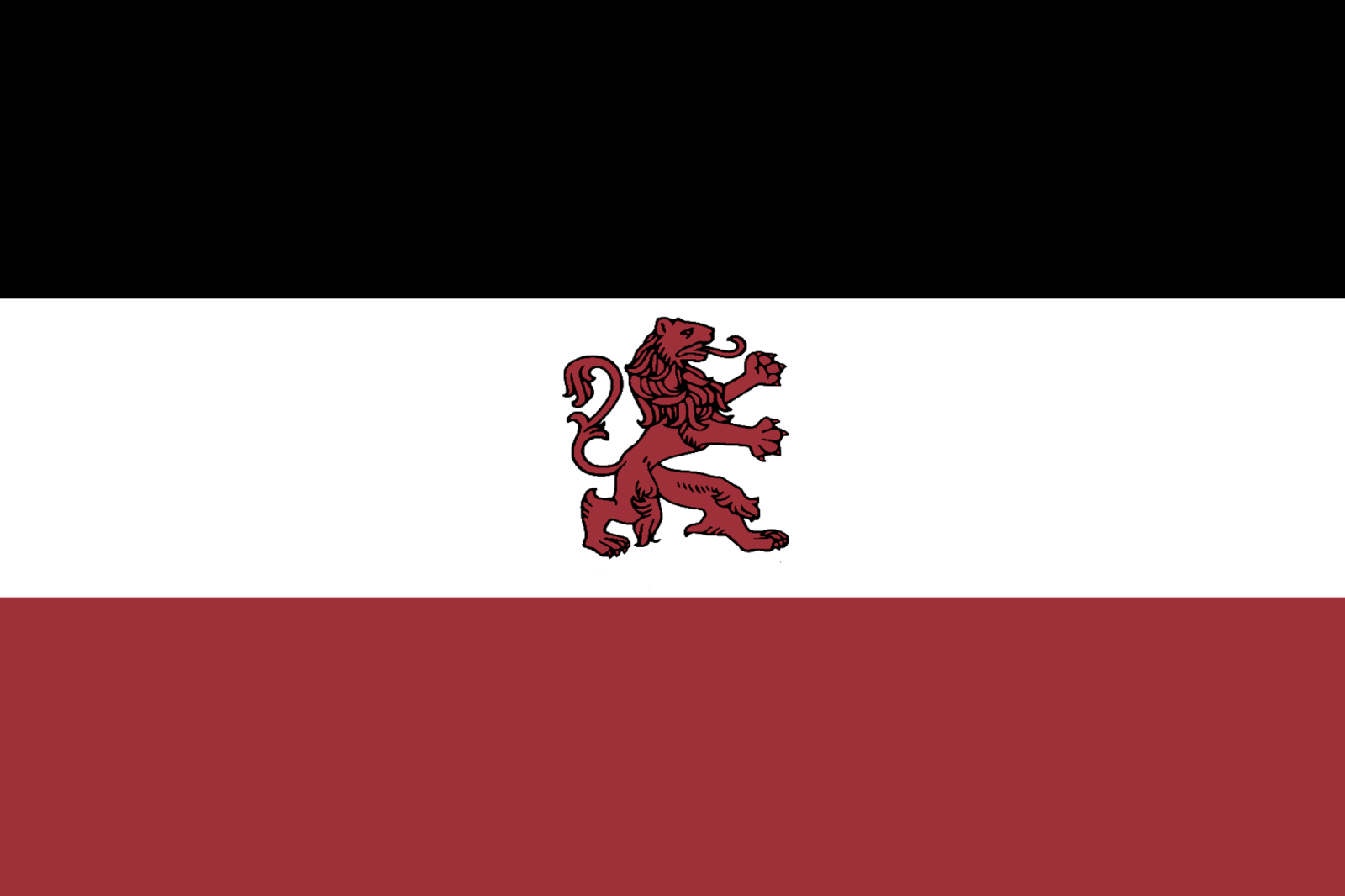
Friday Flag - Kurland
With the victory of the Central Powers in the Great War the German Empire established the new country of Kurland. This German puppet included the cities of Riga in the north to Brest-Litovsk in the south. The islands of Ösel and Dagö.
Inspiration for this flag came from the Atlas of World War I by Martin Gilbert (ISBN 0-19-521077-8). On page 46 was a map of 'German War Aims In Eastern Europe 1914-1918' which showed Kurland, a tiny landlocked Poland, and Ukrainian People's Republic.
The lion rampant is from the coat of arms of Courland. The colors are from the German and Latvian flags.
24 September 2015
Chilean-American War
The ascendancy of Chile after the War of the Pacific also lead to an increase in tensions between Chile and the United States. The 1885 Panama Crisis was one example of this tension. During the Chilean Civil War of 1891 the Itata incident saw the US seizing a ship carrying weapons to the Congressist faction in the conflict. The US was attempting to increase its influence in Chile by supporting President José Manuel Balmaceda.
Balmaceda lost the war to the Congressist faction. A month after the war was over the USS Baltimore arrived in the Chilean port of Valparaiso. On 16 October 1891 outside a saloon in Valparaiso an American sailor spit on a picture of a Chilean hero. In the resulting riot two US sailors were killed and over a dozen were injured. Many of the sailors involved were arrested by the local authorities. The new Chilean government, already upset with US actions during the civil war, rejected all of America's protests.
Secretary of State James G. Blaine had recently died of the chronic illnesses he suffered from. Without his advice President Harrison continued his bellicose rhetoric against Chile. On 11 December 1891 the Chilean response to Harrison arrived. By the afternoon President Harrison was asking Congress for a declaration of war against Chile. On 18 December 1891 The US Congress vote was 292 to 21 in the house and 39 to 35 in the Senate as a Joint Resolution.
The US military was unprepared for a a war with Chile. Construction of new ships and transports began while volunteers were being trained. By mid-April 1892 a force was ready to be deployed. 12 August 1892 saw the city of Iquique occupied by over 5,000 American troops.
During the months after the Declaration of War, Chile began to move its own forces to the northern portion of the country to counter any American invasion. While spread out over a large area, 40,000 Chilean troops were available, many of them battle-hardened during the civil war. While the Americans had better equipment they had long supply lines and were outnumbered by a foe who was fighting for their homes.
The US Navy was able to dominate the local waters. Only small naval encounters played out with the Chilean Navy resorting more to commerce raids on American commercial vessels. The blockade of Iquique and other northern ports was secure.
However, on 21 September 1892 a large-scale operation against the occupied territories was successful. Over 1,000 US soldiers died, most of the others were wounded and/or captured. It was a major disaster with only 413 escaping by sea. While America held the sea now Chile held 2,600 prisoners of war. More troops and ship were being produced in the United States and a larger, more powerful relief force would soon be ready.
The disaster in Chile spelled defeat for Harrison at the ballot box in November. Grover Cleveland won the election and had to plan how he would handle the war.
In late January 1893 the first 10,000 soldiers of a 100,000 force arrived in Peru as a staging area. The number increased to 25,000 by March 1893. Disputes between the US Army and US Navy as well as supplying the troops were problems. A planned two-pronged attack on Iquique and Coyhaique province were planned. Future arrives would reinforce which ever front needed it.
President Cleveland took office on 4 March 1893 just a week before the planned offensive. The President put the offensive on the back burner and opened diplomatic channels with Chile. He felt that enough people had suffered and died over a bar fight. The public backlash was high against Cleveland with unrelenting assaults by the press on a daily basis. The blockade of Chile was kept in place during negotiations. By June he submitted a treaty to the Senate. The treaty would see to the release of all prisoners, including the arrested crew members of the Baltimore, and the US would pay $200,000 in gold for damages to Iquique and from the blockade. The treaty only received 33 of the 59 votes it needed. They country was at war with a Commander-in-Chief who didn't want the war and a Senate that didn't want to end it.
Disease struck the military camps in Peru during August so any military operations would have to be delayed. During the three worst months of the outbreak over 3,800 Americans died. This delay did allow President Cleveland to try to acquire Easter Island from Chile in order to sweeten the deal for the Senate. By having the reparations be considered a purchase it might have a chance of passing.
November 1893 public pressure in the United States was forcing Congress' hand regarding the war. Despite the Democratic majority in the House a call was made to begin impeachment proceedings against the President for failing to carry out his duties as Commander-in-Chief, that failure leading to the loss of thousands of men to malaria and other tropical diseases as thousands of others suffered in prison camps.
On 15 December 1893 the President finally broke under the pressure. He resigned his office and Adlai Stevenson I was sworn in as the new President. Stevenson quickly organized a new campaign on Chile. Heavy fighting over the next four months on three fronts forced Chile to surrender on 14 May 1894. Five thousand additional Americans died, over 10,000 Chilean troops and thousands of civilians due to indirect fire, lack of supplies, and disease.
President Stevenson
The United States seized Easter Island and claimed $250,000 in reparations from Chile. Most of the money would never be paid as on June 3, 1884 Peru and Bolivia both declared war on Chile.
Grover Cleveland is actually one of my favorite presidents so I hope I didn't make him seem too much of a wuss in this alternate history. Perhaps he would have had no problem continuing a silly war since Britain did have some influence in Chile at the time... not sure if they had as much after the Chilean Civil War of 1891.
1) The Baltimore Crisis
2) United States intervention in Chile
3) Baltimore Affair
4) Adlai Stevenson
Balmaceda lost the war to the Congressist faction. A month after the war was over the USS Baltimore arrived in the Chilean port of Valparaiso. On 16 October 1891 outside a saloon in Valparaiso an American sailor spit on a picture of a Chilean hero. In the resulting riot two US sailors were killed and over a dozen were injured. Many of the sailors involved were arrested by the local authorities. The new Chilean government, already upset with US actions during the civil war, rejected all of America's protests.
Secretary of State James G. Blaine had recently died of the chronic illnesses he suffered from. Without his advice President Harrison continued his bellicose rhetoric against Chile. On 11 December 1891 the Chilean response to Harrison arrived. By the afternoon President Harrison was asking Congress for a declaration of war against Chile. On 18 December 1891 The US Congress vote was 292 to 21 in the house and 39 to 35 in the Senate as a Joint Resolution.
The US military was unprepared for a a war with Chile. Construction of new ships and transports began while volunteers were being trained. By mid-April 1892 a force was ready to be deployed. 12 August 1892 saw the city of Iquique occupied by over 5,000 American troops.
During the months after the Declaration of War, Chile began to move its own forces to the northern portion of the country to counter any American invasion. While spread out over a large area, 40,000 Chilean troops were available, many of them battle-hardened during the civil war. While the Americans had better equipment they had long supply lines and were outnumbered by a foe who was fighting for their homes.
The US Navy was able to dominate the local waters. Only small naval encounters played out with the Chilean Navy resorting more to commerce raids on American commercial vessels. The blockade of Iquique and other northern ports was secure.
However, on 21 September 1892 a large-scale operation against the occupied territories was successful. Over 1,000 US soldiers died, most of the others were wounded and/or captured. It was a major disaster with only 413 escaping by sea. While America held the sea now Chile held 2,600 prisoners of war. More troops and ship were being produced in the United States and a larger, more powerful relief force would soon be ready.
The disaster in Chile spelled defeat for Harrison at the ballot box in November. Grover Cleveland won the election and had to plan how he would handle the war.
In late January 1893 the first 10,000 soldiers of a 100,000 force arrived in Peru as a staging area. The number increased to 25,000 by March 1893. Disputes between the US Army and US Navy as well as supplying the troops were problems. A planned two-pronged attack on Iquique and Coyhaique province were planned. Future arrives would reinforce which ever front needed it.
President Cleveland took office on 4 March 1893 just a week before the planned offensive. The President put the offensive on the back burner and opened diplomatic channels with Chile. He felt that enough people had suffered and died over a bar fight. The public backlash was high against Cleveland with unrelenting assaults by the press on a daily basis. The blockade of Chile was kept in place during negotiations. By June he submitted a treaty to the Senate. The treaty would see to the release of all prisoners, including the arrested crew members of the Baltimore, and the US would pay $200,000 in gold for damages to Iquique and from the blockade. The treaty only received 33 of the 59 votes it needed. They country was at war with a Commander-in-Chief who didn't want the war and a Senate that didn't want to end it.
Disease struck the military camps in Peru during August so any military operations would have to be delayed. During the three worst months of the outbreak over 3,800 Americans died. This delay did allow President Cleveland to try to acquire Easter Island from Chile in order to sweeten the deal for the Senate. By having the reparations be considered a purchase it might have a chance of passing.
November 1893 public pressure in the United States was forcing Congress' hand regarding the war. Despite the Democratic majority in the House a call was made to begin impeachment proceedings against the President for failing to carry out his duties as Commander-in-Chief, that failure leading to the loss of thousands of men to malaria and other tropical diseases as thousands of others suffered in prison camps.
On 15 December 1893 the President finally broke under the pressure. He resigned his office and Adlai Stevenson I was sworn in as the new President. Stevenson quickly organized a new campaign on Chile. Heavy fighting over the next four months on three fronts forced Chile to surrender on 14 May 1894. Five thousand additional Americans died, over 10,000 Chilean troops and thousands of civilians due to indirect fire, lack of supplies, and disease.
The United States seized Easter Island and claimed $250,000 in reparations from Chile. Most of the money would never be paid as on June 3, 1884 Peru and Bolivia both declared war on Chile.
Grover Cleveland is actually one of my favorite presidents so I hope I didn't make him seem too much of a wuss in this alternate history. Perhaps he would have had no problem continuing a silly war since Britain did have some influence in Chile at the time... not sure if they had as much after the Chilean Civil War of 1891.
1) The Baltimore Crisis
2) United States intervention in Chile
3) Baltimore Affair
4) Adlai Stevenson
11 September 2015
Friday Flag - Duchy of Djibouti
In 1937 the Duchy of Djibouti was on of two colonies of the Królestwo Zachodnim Afganistanie that gained independence. The KZA's naval power was almost non-existent and the regular military conflicts with China and rebel hunting in the Russian Empire took nearly all of the nation's focus. It was felt that releasing the colonies from the Kingdom would allow them to better develop on their own.
The odd mix of politics and religion from the Królestwo Zachodnim Afganistanie carried over to the Duchy of Djibouti. Duke Cumar Grabowski took over as head from his father, Duke Stanislaw Grabowski. Prime Minister Xasan Aref Geelle controlled many day-to-day operations as the new country made a step towards becoming a constitutional monarchy. During the original colony's founding a large portion of southern Ethiopia was conquered and added to the Duchy.
A war between Djibouti and Ethiopia form 1940 to 1942 helped solidify the new nation and in the end brought Djibouti and Ethiopia on a road to lasting peace. As part of the terms of the Djibouti victory in the conflict, Prince Ismaaciil Grabowski would marry Princess Tsehai Haile Selasasie of Ethiopia. She was the youngest daughter of the Ethiopian emperor.
07 September 2015
Money Monday #6 - US Territorial Notes
With increasing tensions and threat of war with the Empire of Japan, the United States was determined to keep its money out of enemy hands if its territories were invaded. This idea eventually evolved into the 'Blue Back,' a territorial currency for use during the time of crisis. The first notes were issued in fall of 1941 and would be in circulation until 1948 (other than the Kamchatka-Chukotka & Philippines notes which were withdrawn after the 1942 invasion).
Each note had a letter designation for the territory it originated. If one of these territories fell to enemy forces the related money would automatically become contraband and have no value.
A: Hawaii
B: Alaska
C: Kamchatka-Chukotka
D: Philippines
E: Guam and other Pacific possessions
Over $580 million of territorial notes were printed. Various denominations and designations made up this total, mostly for Hawaii.
By the 1980s surviving 'Blue Backs' were worth quite a bit to collectors, especially the 'C' series.
Inspiration for this post came form the OTL Hawaii overprint notes issued during World War II.
06 September 2015
Book Review - CSS Appomattox
THE STORY
Once you get past the whole Confederate victory in the Civil War the story isn't bad.
Set a couple of decades after the Confederate States of America won their independence. The book starts out as a military fiction the crew of the airship Appomattox have a number of adventures. This leads them to becoming part of a military intelligence unit.
The USA agrees not to intervene in a war the German Empire starts with Spain to gain territory in the Caribbean. The CSA gives support to the Spanish Empire including military aid. The CSS Appomattox is a Confederate airship, under the command of Thomas Devareaux, is patrolling the Atlantic searching for German naval groups.
The Appomattox bloodies a Germany battle group, destroying some enemy airships that were flying cover. As the Confederate ship is being repaired much of the crew is drafted into intelligence operation in the Caribbean including infiltrating the jungle on occupied islands taken by the Germans. Devareux's personal life and traitors withing the Confederacy get drawn together in the backdrop of the war.
There is good pacing and a variety of action. The story itself is self-contained but has a number of loose ends and seems ready for a sequel.
THE CHARACTERS
Thomas Devareaux is of the standard heroic mold. He does have a romantic backstory with the daughter of a higher ranking officer. The bumps in that long-distance relationship add some chaos to Devereaux's life and have a further connection to the story. Most of the other crew members of the Appomattox are likable enough despite being Confederates.
FINAL THOUGHTS
Some of the technological innovations developed by the Confederates seemed a bit far-fetched, while airships are cool and all the CSS Appomattox seemed pretty advanced for the time. Technology-wise the CSA seemed to be keeping up with the USA. Given the difference in population and industry between the two nations the CSA would eventually fall behind relying on stealing technology from their northern neighbor. Then again the old Soviet Union was able to project a pretty good illusion about their technology and capabilities back in the day.
The battles with the German airships were entertaining. The portions of the story set in the jungles of occupied territories were interesting as well.
Overall the book was fun. I enjoyed the story and look forward to future chapters in series.
4 or of 5 stars.
NOTES
Author: Chris Stoesen
Print Length: 273 pages
Available for Kindle at Amazon.com
31 August 2015
Wilson Assassinated!
Paris 1919. The victorious Allied leaders met to distribute the booty from the Great War. President Wilson arrived to push the principles of his Fourteen Points. But as the negotiations stretched on he abandoned more and more of his ideals and became obsessed with his idea for a League of Nations.
Wilson, Clemenceau, and Lloyd George had numerous discussions of the fate of the Ottoman Empire. The original ideals of self-determination were tossed aside as France and Britain fought over the new borders to be drawn across Asia Minor and the Middle East. Greek military forces were arriving to seize land for Greece, Italy demanded concessions, and America was offered a mandate over Armenia and Constantinople.
On 18 June 1919 the Allied leaders did something they didn't do for the other Central Power governments, they met with Turkish Prime Minister and his aides. Perhaps it was the general disdain the Allies had for the Ottoman Empire, or perhaps the meeting was just for show. Damad Ferid attempted to make a case for not destroying the Ottoman Empire. While neither Ferid nor his aides heard the discussions of the Allied leaders after they left it was apparent from their demeanor that they felt nothing but contempt for the Prime Minister.
Wilson was quoted as having "never having seen anything more stupid." Clemenceau and George were offended by the appeal.
Güvenҫ Peynírcí was one of the last minute additions to Damat Ferid's group. He had an ulterior motive for going to Paris. Once he realized from the looks his people received from the Allied leaders he knew he much take a more drastic course of action. The next day, 19 June, just before lunch, he managed to get close to President Wilson and fired three shots into the American leader.
Wilson died almost instantly. Peynírcí was captured and would be executed by the end of the year. However his deed was done. Thomas Riley Marshall was now the President of the United States. American outrage at the assassination would lead to a dreadful cycle of violence in the near East and the spread of Bolshevism into Turkey. America accepted the Armenian Mandate as well as governorship of Constantinople.
A Great War sparked by an assassination ended with another.
SOURCES
Some of the background details for this post were inspired by Margaret Macmillan's Paris 1919: Six Months That Changed The World. A brief account of Ferid's meeting with the Allied leaders was given on p.437 of the Random House trade paperback edition of that book.
Labels:
Armenia,
Divergence 1919,
Gamma-003,
Ottoman Empire,
Turkey,
USA
28 August 2015
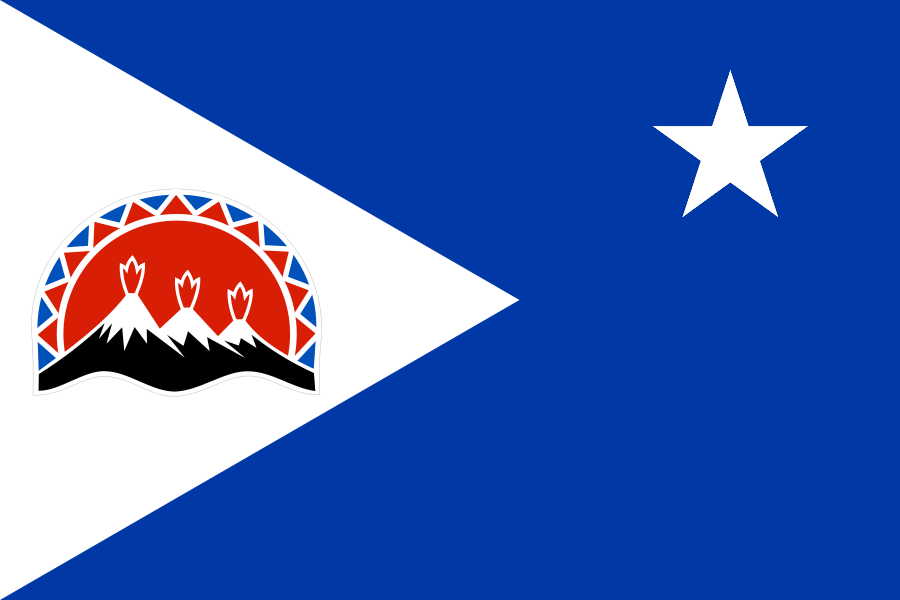
Friday Flag - Kamchatka-Chukotka Territory
As the Russian Civil War raged across east Europe and north Asia the United States of America sent an expeditionary force to help the White Russians. This force was sent to the Russian Far East and additional troops were sent in a show of strength against the Japanese. However, after regular interactions with Admiral Kolchak it became apparent that the Whites were doomed and the Bolsheviks would win the long, bloody struggle.
After spending lives and resources in a futile conflict it was decided to make the best of things by occupying the population centers of Kamchatka and Chukotka. In 1921 America offered Lenin relief supplies and money in return for the territories. Lenin, seeing the offered items as more useful in the struggle in Europe than in the far off tundra, agreed and sold the land. The Kamchatka-Chukotka Territory was born.
The discovery of gold and other unexploited resources brought immigrants from the US and other areas. Development began to take place. However the Second World War would derail this development.
In spring 1942 Japanese forced landed in Kamchatka-Chukotka and drove the remaining, limited, American forces into the wilderness. The difficulties of reconquest and the larger concerns in the Pacific lead to the territory being effectively abandoned. The United States spent more of its efforts in the Pacific than in Europe in the war as a result. A land invasion of Japan took place in 1944 and the Japanese surrendered in 1946.
The Soviet Union, under Trotsky, invaded and re-annexed Kamchatka and Chukotka in 1945. The United States was powerless to stop them. Soviet forces also occupied all of Germany as well as norther Italy as the European war ended in 1945.
Several thousand American soldiers who survived the Japaneses invasion were captured by the Soviets and few were ever returned home.
Subscribe to:
Posts (Atom)