Showing posts with label Russia. Show all posts

28 August 2015

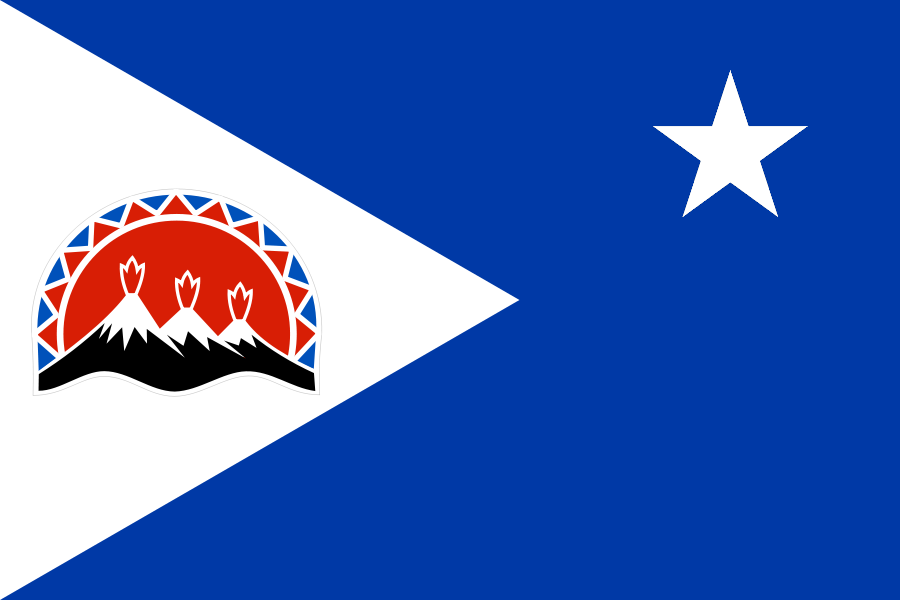
Friday Flag - Kamchatka-Chukotka Territory


As the Russian Civil War raged across east Europe and north Asia the United States of America sent an expeditionary force to help the White Russians. This force was sent to the Russian Far East and additional troops were sent in a show of strength against the Japanese. However, after regular interactions with Admiral Kolchak it became apparent that the Whites were doomed and the Bolsheviks would win the long, bloody struggle.

After spending lives and resources in a futile conflict it was decided to make the best of things by occupying the population centers of Kamchatka and Chukotka. In 1921 America offered Lenin relief supplies and money in return for the territories. Lenin, seeing the offered items as more useful in the struggle in Europe than in the far off tundra, agreed and sold the land. The Kamchatka-Chukotka Territory was born.

The discovery of gold and other unexploited resources brought immigrants from the US and other areas. Development began to take place. However the Second World War would derail this development.

In spring 1942 Japanese forced landed in Kamchatka-Chukotka and drove the remaining, limited, American forces into the wilderness. The difficulties of reconquest and the larger concerns in the Pacific lead to the territory being effectively abandoned. The United States spent more of its efforts in the Pacific than in Europe in the war as a result. A land invasion of Japan took place in 1944 and the Japanese surrendered in 1946.

The Soviet Union, under Trotsky, invaded and re-annexed Kamchatka and Chukotka in 1945. The United States was powerless to stop them. Soviet forces also occupied all of Germany as well as norther Italy as the European war ended in 1945.

Several thousand American soldiers who survived the Japaneses invasion were captured by the Soviets and few were ever returned home.

11 February 2015

Birth of the Hungarian Soviet

When Russia was knocked out of the Great War in 1917 Romania was finding itself in an increasingly difficult position.

In early 1918, Still desiring a 'Greater Romania' it was decided to continue the war against the Central Powers. On 4 March German, Bulgarian, and Austro-Hungarian troops quickly initiated assaults into Moldava. Despite the poor quality of the remaining troops of the Central Powers and the good showing of the Romanians in 1917 the new campaigns went poorly for Romania. Without Russian support and quickly dropping morale Romania was doomed in new campaign.

On 18 April 1918 the central authority in Romania collapsed and the Russians took the opportunity to move into Bessarabia. The Romanian troops in that area fled, some to their occupied homeland while others joined the Russians.

Not long after, the Central Powers were defeated. The Austro-Hungarian Empire then collapsed. on 21 March 1919 Communists seized power in Hungary under Béla Kun. The Hungarian Red Army moved to crush opposition and then turned its eyes towards the crippled Romanian territories.


With Russian help, and little real opposition from Allied forces, the Hungarians maintained their claim on the conquered lands. The Hungarian Soviet was founded. It would spend years trying to consolidate its territory and putting down counter-revolutions. Lenin, seeing the value in aiding their Hungarian comrades supplied additional troops and what weapons he could to Kur.

In 1938 when the Supreme Soviet of the Soviet Union was established the Hungarian Soviet was absorbed into the Soviet Union itself. The Hungarian Soviet Republic gained 32 deputies in the Soviet of Nationalities while Romania was made a autonomous republic with 11 deputies to the same. Transylvania remained in the Hungarian Soviet. A large standing army is then maintained in the Hungarian plains, a perceived threat to the new and weak nations of the Balkans and Central Europe.


NOTES/REFERENCES
1) The Romanian Battlefront in World War I by Glenn E. Torrey
2) Supreme Soviet of the Soviet Union
3) Béla Kun

04 September 2014

Great War 1912 - Mobilization

The Chairman of Council of Ministers of the Russian Empire, Pyotr Stolypin, having survived an assassination attempt in 1911 continued his duties. He would attempt to steer his nation away from war in November 1912 but fail.

The Balkan War was in full swing. Bulgaria was leading Serbia, Greece, and Montenegro on successful campaigns against the Ottoman Empire. Germany and Austria-Hungary were remaining relatively uninvolved in the conflict. The Kaiser was still upset over the overthrow of his friend, Sultan Abdul Hamid II in 1909. Germany would follow a policy of "free fight and no favor", allowing the conflict to play itself out. Despite Serbian gains in the area, including gaining access to the Adriatic were threats to Austrian power in the region the Austro-Hungarians did not mobilize and enter the fight.

Seeing the lack of Austrian involvement as weakness, Russian Minister of War Vladimir Sukhomlinov saw an opportunity to move against the Turks and have a chance at finally seizing Constantinople. Russia could not afford to allow the city to fall into Bulgaria's hands. On 22 November 1912 Sukhomlinov prepared plans for a 'partial' mobilization of Russian forces from Warsaw through Kiev and all the way to Odessa. They could move into the Balkans and either 'aid' the Bulgarian faction and claiming Constantinople for Russia, or they could crush the Balkan armies and seize the city anyway.

The next day, 23 November, the Tsar called an emergency meeting of his most important ministers. There were to discuss Sukhomlinov's plan and other options available. Chairman Stolypin warned against the mobilization. He felt that the Austrians would see it as a direct threat and mobilize themselves. At that point war with the Turks, Austria, and even Germany would be a real possibility.

While a number of other ministers were in agreement with Stolypin's position he was growing increasingly unpopular due to continued pushes for reforms. The same unpopularity that led to the attempt on his life a year earlier kept enough ministers from siding with him to defeat the Minister of War's plan. In a narrow decision the Tsar and his ministers decided on a partial mobilization against the Ottoman Empire and possibly Bulgaria.

Russian mobilization began 24 November (7 December 1912 Gregorian Calendar). The Austrians would react. Mobilizing their military forces to deploy against the Bulgarian alliance and to reinforce border regions with Russia, in particular Przemyśl Fortress. It would not take long for war to spread.


Information on the historical figures can be found on Wikipedia or by using Google, Bing, or whatever search engines you like. I used a couple books as reference when plugging away at this timeline:

1) The Russian Origins of the First World War by Sean McMeekin
2) Blood on the Snow by Graydon A. Tunstall

29 June 2014

This Week in Alternate Histories - June 23 to June 29


JUNE 23
Alt-Timeline: Travaillis Republique Democratique
Year: 2014
The Brittany region of France finally achieves independence. Since the end of the war over sixty years ago Brittany had recovered more quickly and was more open to working with the UK & USA. On June 23 the Grand Alliance of Europe recognizes Brittany as an independent nation over French protests.


JUNE 24
Alt-Timeline: Alexander's Earth
Year: 2151 native calendar (AD 1820)
Nearly fifteen years after the Unknown War devastated the Earth, the inhabitants of Almazangrad emerge from their underground city and begin to explore the desolate area around their settlement. Initial explorations show only slightly elevated background radiation in the area around the city giving hope to the survivors of expansion and accumulation of desperately needed resources.

JUNE 25
Alt-Timeline: Alternate Great Lakes
Year: 1788
Virginia becomes the 9th state to ratify the US Constitution. Saint Lawrence has refused to join the new union.

JUNE 26
Alt-Timeline: Sino-Soviet Alliance
Year: 1945
The United Nations charter is signed. A controversial section of the charter allows for a formation of a UN military which would cause trouble when the Soviet Union fails to utilize its veto power at the start of the Korean War. In the future this would be seen as the primary weakness of the new organization and the rise of a more powerful international communist organization in the '50s.

JUNE 27
Alt-Timeline: British North America
Year: 1768
The Treaty of Fort Stanwix is signed between the British and the Iroquois Confederacy. It establishes the borders of Iroquois territory and creates provisions for the British to enforce violations by colonists.

JUNE 28
Alt-Timeline: Campi Flegrei
Year: 1955
A major Nazi air attack with most of their jet fighters breaks the back of the Red Army at the start of the Battle of Radom. This battle marked the limit of the Russian advance into Germany territory.

JUNE 29
Alt-Timeline: World War III
Year: 1963
An agreement is finalized with President João Goulart of Brazil and elements of the US Navy to use Brazilian ports for resupply in the aftermath of the nuclear exchange sparked by the Cuban Missile Crisis. The chaos of the global war and shifting weather patterns is causing problems worldwide, but the presence of the Navy vessels helps stabilize the ports and stimulates economic activity.

08 May 2014

A night at The Tale of Tsar Saltan

On 1 September 1911 (14 September in the Gregorian calendar) Russian prime minister Pyotr Stolypin attended a performance of the opera, The Tale of Tsar Saltan, at the Kiev Opera House. Tsar Nicholas II was also in attendance. The opera was about the betrayal of a Tsar by the older sisters of his wife.


During the intermission a man named Dmitri Bogrov approached Stolypin and drew a revolver. Two shots rang out and Stolypin dropped, a small spray of blood emerging from him. Bogrov was quickly wrestled to the ground and disarmed. Upon examination the prime minister was alive. He had a gunshot wound in his arm and received two broken ribs from the impact of the second bullet into his bulletproof vest.

How Bogrov entered the opera house with a weapon while the Tsar was in attendance was a mystery, a mystery few seemed interested in solving. The would-be-assassin was hanged three days after the attempt and further investigations were stopped by order of the Tsar. A supposed anarchist terrorist was able to get close enough to possibly kill the Tsar and that same Tsar seemed uninterested in determining if anyone else was involved or how those sworn to protect him could allow an armed man so close. The quick execution of the terrorist and the lack of investigation was troubling.

The Prime Minister received the message - even if one wasn't being sent. He felt that it was not a random anarchist who tried to kill him but someone in the government wanted him dead. Just as in the opera the Tsaritsa and her son were betrayed and nearly killed in a barrel at sea he became more subtle in his drive for reforms and in the pursuit of rebels, but remained unpopular with many of the other ministers and military leaders. He would eventually resign in disgust with the outbreak of the Great War in November 1912.

No magic swan arrived to keep Russia out of the war.


NOTES
A possible timeline I'm developing where World War I begins a couple of years early. I hope to post more in the coming weeks to see how things develop. If you have any ideas or opinions please feel free to leave a comment.
1) Some information on the assassination of Pyotr Stolpin over at HistoryToday.com
2) A synopsis of opera "The Tale of Tsar Saltan" - this is the opera that The Flight of the Bumblebee came from. Also of note is that I've been subjected to that particular music countless times thanks to it being the theme for the old Green Hornet radio program!
3) A YouTube clip of the music of the opera I listened to for part of the time I was working on this post
4) Image of Pyotr Stolypin from Wikimedia Commons - public domain in the USA due to age.

14 April 2014

Second Crimean War 1918 to 1919


In the decade after the Baltic Event the Russian Empire attempted to rebuild and recover what lost territory it could. Tsar Cyril finally turned his attention on Ukraine in 1918. The Russian Navy had never recovered from the losses of the Russo-Japanese War and the Baltic Event, however a bulk of the surviving ships were in the Black Sea Fleet. That fleet was stationed in Sevastopol, an Imperial enclave in Ukraine. With the diminished strength of the Ukrainian military after the Polish-Ukrainian War of 1912-1914 and continued tension between those two countries Russia struck.

On 12 June 1918 three-hundred thousand Russian troops invaded Ukraine with the stated purpose of annexing Crimea to the Russian Empire. The Black Sea Fleet departed to bombard Odessa, attacking that city on 18 June. The tiny Ukrainian Navy was destroyed.

The Austro-Hungarian Empire, wary of Russian expansion back into Europe, intervened on 7 August 1918 with a declaration of war on Russia. The Habsburg contribution to the war was only a naval battle group built around the SMS Viribus Unitis. That squadron under Rear Admiral Miklós Horthy hunted down and wiped out the Black Sea Fleet on 20 October 1918 at the Battle of Karkinit Bay. Austria-Hungary kept its involvement in the war limited to keeping the Russians from staging further naval attacks on Ukraine, only a volunteer army unit took place in land operations.

By the arrival of winter Russian troops occupied most of Crimea. The Ukrainian military was continuing to mobilize and set up a series of trenches across the north end of the peninsula.

By spring 1919 full-scale hostilities resumed. The initial Russian assaults on the Ukrainian trenches failed with the loss of many Russian soldiers. On 14 May 1919 Russia ignored the Crimean front and launched a three-pronged assault across their common border with Ukraine. The Ukrainian military was overwhelmed and the Russians broke through. On 20 May the Russians had the Crimean trenches surrounded. That, along with Polish troops massing on Ukraine's other border led to their surrender on 24 May.

Russia annexed Crimea, but had suffered some heavy casualties against the machine guns Austria provided to the Ukrainians. Further Russian plans to expand into Ukraine were abandoned as a result. Tsar Cyril decided further recoveries of territory should be made in central Asia where the cost and interference of other European powers would be less.


NOTES
I've decided to expand a few existing timelines this spring/summer. One of them will be the Baltic Event timeline where the Tunguska blast occurred instead in the Baltic Sea and crippled the Russian Empire.

Tsar Cyril is Cyril Vladimirovich, the closest to the throne after the deaths of the Imperial family during the event.

I created the logo for this post using the Russian and Ukrainian flags, the Ukrainian coat of arms, and an image of flame.

07 March 2014

Friday Flag - Sino-Soviet Alliance


In 1951, months after the Peoples' Republic of China entered the Korean War, United Nations forces were escalating their attacks to drive out the new invader. The Soviet Union became increasingly alarmed with the combat taking place near its border. When an American atomic bomb was dropped on Chinese troop concentrations in China the Soviet Union withdrew from the United Nations taking the other communist bloc nations with it.

An informal military alliance was forged between the Soviets and Chinese. Russian military forces were shifted to the east and entered the Korean War. Panic of the war spreading to Europe, which still was in ruins from the Second World War, caused mass migrations and a majority of people to move out of West Berlin to more secure areas of West Germany.

IN 1952 The Sino-Soviet Alliance, which includes the Warsaw Pact nations is forged. A new flag for the alliance is revealed. The first public use of the new flag is to fly it over the former West Berlin as it is annexed by the East in July.

The war continues for several more years in Korea with a catastrophic loss of life.

06 March 2014

The Baltic Event

On 30 June 1908 disaster struck the Earth. At 3:14 am local time the Baltic Sea, just south and east of Åland Islands.

A tsunami was caused by the impact. The angle and velocity of the impact sent a larger portion of the water east. A huge wave was funneled down the Gulf of Finland. Coastal areas along the way were devastated. Helsinki, Tallinn along with other larger settlements are devastated. Some smaller villages are completely washed away. The tsunami actually intensifies as it travels down the Gulf. It strikes St. Petersburg with overwhelming force.

The Winter Palace is devastated and the Imperial Family is killed. Other centers of governmental power for the Russian Empire are destroyed. Governmental control is decapitated.

The Åland Islands have their surface obliterated. Waves pummel Stockholm and destroy a large portion of the Swedish government.

Less devastating waves finally reach the German Empire. While no-where near as destructive as the easterly and westerly waves it is enough to destroy a portion of the German Navy and to ruin a number of ships under construction in the shipyards.

Over the next decade and beyond the Russian Empire is in chaos. Revolution and separatist groups tear at the corpse of the Empire. After the first year of rebellions growing numbers of soldiers begin to long to return home knowing that their homelands may be in danger. Mutinies strike many of the regions of the military.

The United Kingdom, Germany, and France send as much aid as possible the the Baltic region. Denmark even occupies a portion of Swedish territory to 'protect' this humanitarian aid. They never leave.

The death toll of the Baltic Event is unknown but is in the hundreds of thousands. This is followed by starvation, disease, and in Russia's case War. As mentioned these wars span over a decade and give birth to dozens of new nations. By June 1918 this is a map of the region:


The nations existing out of the former territory of the Russian Empire include:
(1) The Russian Empire (in red), (2) Finland, (3) Poland, (4) Ukraine, (5) Kazakhstan, (6) Kara-Kyrgystan, (7) Uzbekistan, (8) Tajikistan, (9) Turkmenistan, (10) Azerbaijan, (11) Georgia, (12) Komi, (13) Maykopiya, (14) Elista, (15) Dagestan, (16) Chechnya, (17) Angusht, (18) Far East Federation, (19) Free Land of Bidzhan (Manchurian enclave), (20) Lesser Transbaikalia, (21) Yenisei, (22) Khakassiya, (23) Izhevsk Zavod, (24) Bashkortostan, (25) Tatarstan, (26) Cheboksaryia, (27) Mariy-El (28) Yakutiya, (29) Kabardiniya, (30) Batalpashinsk, (31) Ulala, (32) Kareliya, (33) Mongolia,

Russia if focusing on re-establishing control over the Caucasus region. It is also has poor relations with Kareliya and Komi, desiring that former territory as well. As of 1918 the borders of all of these nations are still not permanent. Ethnic groups are fighting for territory, resources, ancestral lands, and strategic locations to protect their territory. It will be another generation before things begin to stabilize.


I altered history on this one by changing the timing and exact nature of what was the Tunguska Blast on the OTL. A major change to astronomical events would really have a divergence point not too long after the Big Bang. This timeline is mostly to show how devastating things could have been if such an impact hit a little off course.

I might play around a bit with this one. Perhaps a post on a Polish-Ukrainian War, maybe one on the global reaction and changes due to such a devastating event.

A number of the new countries listed above were not even established by Russia until the 1920s. Due to my own lack of time and limited knowledge of 19th century Russia I've ignored a few things. A decade of civil wars is my excuse for anything that looks out-of-place.

I hope you enjoy. Feel free to leave comments.
26 August 2013

The Red War - Part One: Origins


THE RED WAR PART ONE: ORIGINS


The disaster known today as The Red War had its origins in another conflict. That other conflict being the Russo-German War (1914 to 1917).

The Assassination
The catalyst for the start of the Russo-German War was the assassination of Archduke Francis Ferdinand, Inspector-General of the Austro-Hungarian Army and Heir to the Throne of the Empire. Ferdinand died in Sarajevo after being shot by a Serb national on 28 June 1914.

Calm Before the Storm
On the 5th of July the German Empire issued Austria-Hungary a "blank check" in dealing with Serbia. Austria-Hungary issued a harsh ultimatum to Serbia on the 23rd of July that was designed to be refused by the Serbs. That refusal came days later and it looked as if all of Europe could possibly be dragged into war.

28 July 1914 Austria-Hungary declares war on Serbia. Two days later Austria-Hungary mobilized its military. on the 31st Russia did the same. The Russian mobilization led to a flurry of diplomatic activity between Germany and France. Germany convinced France to stay neutral in the conflict since their agreement with the Russians was to come to Russia's aid if it was attacked first - but their mobilization against Austria-Hungary could be categorized as an offensive action releasing France of its obligations.

4 August 1914 the German Empire declares war on Russia to defend their Austrian allies.

The War The Germans made quick gains into Russia in the first few months of the war. Their planned advance up the Baltic coast was delayed by the unexpectedly fast and powerful Russian attack on Austria-Hungary. The poor organization of the Austrian forces led to them being pushed back by the Russians and fighting a terrible winter war across the Carpathians from November 1914 to spring 1915. German plans were placed on hold so they could support their allies.

Serbia managed to hold out against the Austrian forces for over a year. They finally collapsed in October 1915 when Bulgaria joined the war on the side of Germany and aided in the conquest. This should have freed up a large force of Austrian troops to be used against Russia, but the terribly administrative skills of the Austrians made it clear that they would be lucky to be available for the Russian front by the spring of 1916.

Chief of the German General Staff von Moltke did not want to send a large force to decimate the Russian Carpathian armies and save Austria. "Saint Petersburg is to the north, bumbling fools to the south. We march North and to victory!" The summer of 1915 saw the German Baltic campaign against Russia.

The Baltic Campaign
At first German advances up along the Baltic coast met little resistance. Reports of major fortifications being constructed around Saint Petersburg including multiple rings of trenches were received. However without confirmation von Moltke was cautious.

Battle of Tannenberg
September 1915 the bulk of the German invasion force was entering Estonia when Russian General Alexander Samsonov struck. The bulk of Russian forces were not protecting St. Petersburg, but were in the Ukraine. When German supply lines were stretched Samsonov launched his attack through the weak German defensive screen and into Germany itself at the Tannenberg forest.

The Germany Navy controlled the Baltic and could get basic supplies to the German invasion force, but the supplies coming by land were needed for any serious offensive towards the Russian capital. Instead von Moltke sent half of his army back towards home in hopes of trapping the Russian army. The rest of the German invasion force would remain in the Baltic and consolidate its gains.

Back in Germany General Samsonov made some impressive gains and inflicted heavy casualties on the Germans. However in mid-October he came across the newly constructed German trenches and was stopped. Samsonov did not dig in himself knowing that a German army was approaching his rear; instead he fled south to used his forces against the Austrians, and hopefully commit the Germans to sending more forces south themselves.

Erich von Falkenhayn
After the setback at Tannenberg, von Moltke began having major health problems. In November 1915 he was replaced by Erich von Falkenhayn. Over the winter Falkenhayn worked closely with his Austrian counterparts and helped to bring both Romania and the Ottoman Empire into the war in the spring.

In 1916 with the new front opened against Russia by the Ottoman Empire and Falkenhayn's decision to bail out Austria first before making the final push against Russia. Germany and her allies made great gains in the south but a number of things began to concern Falkenhayn. The Russians seemed to willing to trade land for time. There were also rumors about the capital being moved to Moscow, a much more difficult target.

The harsh Russian winters, the seemingly unlimited troops, and the drain on the German economy by the war were adding pressure to finish it quickly..... but the Russians were playing to drag it out as long as possible. It would would take a number of years before the Kaiser could dictate terms to his foe.

Enter, Lenin
The only way Germany could get a quick victory would be for the Russian people to rebel against their Tsar. It would not be possible unless some new element was added to Russia. That element was Vladimir Ilyich Lenin. The political chaos Lenin could unleash on Russia could help end the war in Germany's favor.

In October 1916 Lenin was smuggled into Russia. His revolutionary activities as well as a major German offensive in the spring of 1917 caused a collapse of the Tsar's government by June 1917. Not long after that would be the Russian Revolution and the beginning of The Red War.

05 April 2013

Friday Flag - Russian Federation


I designed this flag many years ago. Basically it's a Romanov crest on a modern Russian flag. I originally designed it for a world where the United States, China, and most of Europe were devastated by a war (in December 1993) that Russia somehow managed to avoid. Russia became one of two dominate powers on Earth after that and nostalgia for the 'good old days' led to the addition of the old crest to the flag.

Not much of an alternate history, but it was for a super-hero role-playing game so realism wasn't that important.
Related Posts Plugin for WordPress, Blogger...