11 September 2015
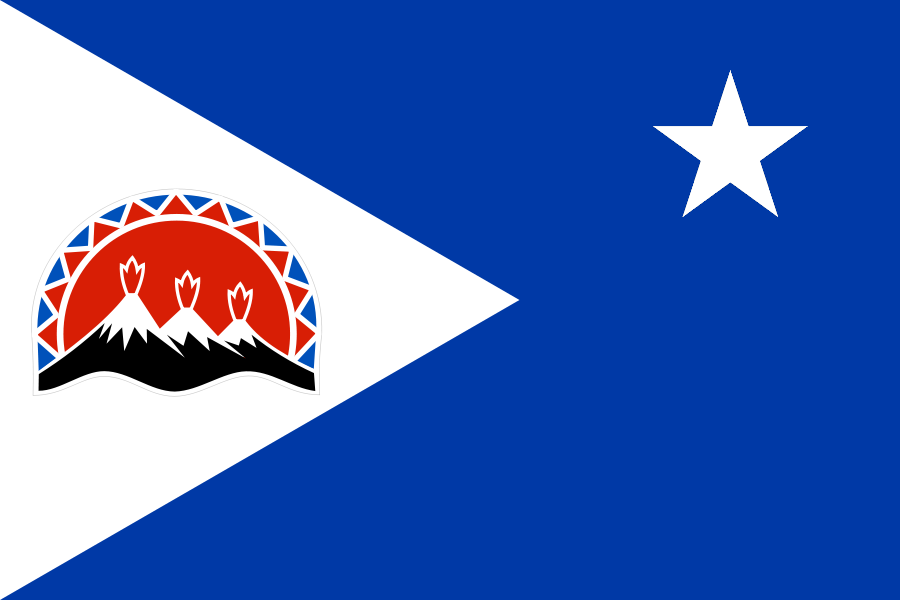
Friday Flag - Duchy of Djibouti
In 1937 the Duchy of Djibouti was on of two colonies of the Królestwo Zachodnim Afganistanie that gained independence. The KZA's naval power was almost non-existent and the regular military conflicts with China and rebel hunting in the Russian Empire took nearly all of the nation's focus. It was felt that releasing the colonies from the Kingdom would allow them to better develop on their own.
The odd mix of politics and religion from the Królestwo Zachodnim Afganistanie carried over to the Duchy of Djibouti. Duke Cumar Grabowski took over as head from his father, Duke Stanislaw Grabowski. Prime Minister Xasan Aref Geelle controlled many day-to-day operations as the new country made a step towards becoming a constitutional monarchy. During the original colony's founding a large portion of southern Ethiopia was conquered and added to the Duchy.
A war between Djibouti and Ethiopia form 1940 to 1942 helped solidify the new nation and in the end brought Djibouti and Ethiopia on a road to lasting peace. As part of the terms of the Djibouti victory in the conflict, Prince Ismaaciil Grabowski would marry Princess Tsehai Haile Selasasie of Ethiopia. She was the youngest daughter of the Ethiopian emperor.
07 September 2015
Money Monday #6 - US Territorial Notes
With increasing tensions and threat of war with the Empire of Japan, the United States was determined to keep its money out of enemy hands if its territories were invaded. This idea eventually evolved into the 'Blue Back,' a territorial currency for use during the time of crisis. The first notes were issued in fall of 1941 and would be in circulation until 1948 (other than the Kamchatka-Chukotka & Philippines notes which were withdrawn after the 1942 invasion).
Each note had a letter designation for the territory it originated. If one of these territories fell to enemy forces the related money would automatically become contraband and have no value.
A: Hawaii
B: Alaska
C: Kamchatka-Chukotka
D: Philippines
E: Guam and other Pacific possessions
Over $580 million of territorial notes were printed. Various denominations and designations made up this total, mostly for Hawaii.
By the 1980s surviving 'Blue Backs' were worth quite a bit to collectors, especially the 'C' series.
Inspiration for this post came form the OTL Hawaii overprint notes issued during World War II.
06 September 2015
Book Review - CSS Appomattox
THE STORY
Once you get past the whole Confederate victory in the Civil War the story isn't bad.
Set a couple of decades after the Confederate States of America won their independence. The book starts out as a military fiction the crew of the airship Appomattox have a number of adventures. This leads them to becoming part of a military intelligence unit.
The USA agrees not to intervene in a war the German Empire starts with Spain to gain territory in the Caribbean. The CSA gives support to the Spanish Empire including military aid. The CSS Appomattox is a Confederate airship, under the command of Thomas Devareaux, is patrolling the Atlantic searching for German naval groups.
The Appomattox bloodies a Germany battle group, destroying some enemy airships that were flying cover. As the Confederate ship is being repaired much of the crew is drafted into intelligence operation in the Caribbean including infiltrating the jungle on occupied islands taken by the Germans. Devareux's personal life and traitors withing the Confederacy get drawn together in the backdrop of the war.
There is good pacing and a variety of action. The story itself is self-contained but has a number of loose ends and seems ready for a sequel.
THE CHARACTERS
Thomas Devareaux is of the standard heroic mold. He does have a romantic backstory with the daughter of a higher ranking officer. The bumps in that long-distance relationship add some chaos to Devereaux's life and have a further connection to the story. Most of the other crew members of the Appomattox are likable enough despite being Confederates.
FINAL THOUGHTS
Some of the technological innovations developed by the Confederates seemed a bit far-fetched, while airships are cool and all the CSS Appomattox seemed pretty advanced for the time. Technology-wise the CSA seemed to be keeping up with the USA. Given the difference in population and industry between the two nations the CSA would eventually fall behind relying on stealing technology from their northern neighbor. Then again the old Soviet Union was able to project a pretty good illusion about their technology and capabilities back in the day.
The battles with the German airships were entertaining. The portions of the story set in the jungles of occupied territories were interesting as well.
Overall the book was fun. I enjoyed the story and look forward to future chapters in series.
4 or of 5 stars.
NOTES
Author: Chris Stoesen
Print Length: 273 pages
Available for Kindle at Amazon.com
31 August 2015
Wilson Assassinated!
Paris 1919. The victorious Allied leaders met to distribute the booty from the Great War. President Wilson arrived to push the principles of his Fourteen Points. But as the negotiations stretched on he abandoned more and more of his ideals and became obsessed with his idea for a League of Nations.
Wilson, Clemenceau, and Lloyd George had numerous discussions of the fate of the Ottoman Empire. The original ideals of self-determination were tossed aside as France and Britain fought over the new borders to be drawn across Asia Minor and the Middle East. Greek military forces were arriving to seize land for Greece, Italy demanded concessions, and America was offered a mandate over Armenia and Constantinople.
On 18 June 1919 the Allied leaders did something they didn't do for the other Central Power governments, they met with Turkish Prime Minister and his aides. Perhaps it was the general disdain the Allies had for the Ottoman Empire, or perhaps the meeting was just for show. Damad Ferid attempted to make a case for not destroying the Ottoman Empire. While neither Ferid nor his aides heard the discussions of the Allied leaders after they left it was apparent from their demeanor that they felt nothing but contempt for the Prime Minister.
Wilson was quoted as having "never having seen anything more stupid." Clemenceau and George were offended by the appeal.
Güvenҫ Peynírcí was one of the last minute additions to Damat Ferid's group. He had an ulterior motive for going to Paris. Once he realized from the looks his people received from the Allied leaders he knew he much take a more drastic course of action. The next day, 19 June, just before lunch, he managed to get close to President Wilson and fired three shots into the American leader.
Wilson died almost instantly. Peynírcí was captured and would be executed by the end of the year. However his deed was done. Thomas Riley Marshall was now the President of the United States. American outrage at the assassination would lead to a dreadful cycle of violence in the near East and the spread of Bolshevism into Turkey. America accepted the Armenian Mandate as well as governorship of Constantinople.
A Great War sparked by an assassination ended with another.
SOURCES
Some of the background details for this post were inspired by Margaret Macmillan's Paris 1919: Six Months That Changed The World. A brief account of Ferid's meeting with the Allied leaders was given on p.437 of the Random House trade paperback edition of that book.
Wilson, Clemenceau, and Lloyd George had numerous discussions of the fate of the Ottoman Empire. The original ideals of self-determination were tossed aside as France and Britain fought over the new borders to be drawn across Asia Minor and the Middle East. Greek military forces were arriving to seize land for Greece, Italy demanded concessions, and America was offered a mandate over Armenia and Constantinople.
On 18 June 1919 the Allied leaders did something they didn't do for the other Central Power governments, they met with Turkish Prime Minister and his aides. Perhaps it was the general disdain the Allies had for the Ottoman Empire, or perhaps the meeting was just for show. Damad Ferid attempted to make a case for not destroying the Ottoman Empire. While neither Ferid nor his aides heard the discussions of the Allied leaders after they left it was apparent from their demeanor that they felt nothing but contempt for the Prime Minister.
Wilson was quoted as having "never having seen anything more stupid." Clemenceau and George were offended by the appeal.
Güvenҫ Peynírcí was one of the last minute additions to Damat Ferid's group. He had an ulterior motive for going to Paris. Once he realized from the looks his people received from the Allied leaders he knew he much take a more drastic course of action. The next day, 19 June, just before lunch, he managed to get close to President Wilson and fired three shots into the American leader.
Wilson died almost instantly. Peynírcí was captured and would be executed by the end of the year. However his deed was done. Thomas Riley Marshall was now the President of the United States. American outrage at the assassination would lead to a dreadful cycle of violence in the near East and the spread of Bolshevism into Turkey. America accepted the Armenian Mandate as well as governorship of Constantinople.
A Great War sparked by an assassination ended with another.
SOURCES
Some of the background details for this post were inspired by Margaret Macmillan's Paris 1919: Six Months That Changed The World. A brief account of Ferid's meeting with the Allied leaders was given on p.437 of the Random House trade paperback edition of that book.
Labels:
Armenia,
Divergence 1919,
Gamma-003,
Ottoman Empire,
Turkey,
USA
28 August 2015
Friday Flag - Kamchatka-Chukotka Territory
As the Russian Civil War raged across east Europe and north Asia the United States of America sent an expeditionary force to help the White Russians. This force was sent to the Russian Far East and additional troops were sent in a show of strength against the Japanese. However, after regular interactions with Admiral Kolchak it became apparent that the Whites were doomed and the Bolsheviks would win the long, bloody struggle.
After spending lives and resources in a futile conflict it was decided to make the best of things by occupying the population centers of Kamchatka and Chukotka. In 1921 America offered Lenin relief supplies and money in return for the territories. Lenin, seeing the offered items as more useful in the struggle in Europe than in the far off tundra, agreed and sold the land. The Kamchatka-Chukotka Territory was born.
The discovery of gold and other unexploited resources brought immigrants from the US and other areas. Development began to take place. However the Second World War would derail this development.
In spring 1942 Japanese forced landed in Kamchatka-Chukotka and drove the remaining, limited, American forces into the wilderness. The difficulties of reconquest and the larger concerns in the Pacific lead to the territory being effectively abandoned. The United States spent more of its efforts in the Pacific than in Europe in the war as a result. A land invasion of Japan took place in 1944 and the Japanese surrendered in 1946.
The Soviet Union, under Trotsky, invaded and re-annexed Kamchatka and Chukotka in 1945. The United States was powerless to stop them. Soviet forces also occupied all of Germany as well as norther Italy as the European war ended in 1945.
Several thousand American soldiers who survived the Japaneses invasion were captured by the Soviets and few were ever returned home.
27 August 2015
I'm Back!
For those keeping score at home it's been about six months since my last post. There were a couple of times this summer I planned on posting, but it has been an incredibly busy year for me. Some good stuff happened, some bad, most just stuff. I've been active in numerous groups, I've increased my reading goals, I've been writing short stories, I'm working on a new role-playing campaign, I've been trying to take free online courses at Coursera, and I even placed in a beard competition. Now that my batteries are recharged I want to get back to blogging.
WHAT'S NEXT?
I've finished designing about a dozen new flags with more on the way. For now I'll be posting one every-other week starting tomorrow afternoon. That should keep at least some regular posting going for a little while.
Book Reviews! - I've read a large number of alternate history books, including a few this summer. It's about time I post more that the handful of book reviews that I've managed so far. I still have to write these reviews, but as soon as I do I'll schedule a regular series of them. I'm not the greatest book reviewer; I've spent too much time in recent years reading stories from old pulp magazines, but I know an interesting story when I read one. Hopefully the reviews will be helpful.
New Worlds! - I carry around a journal whenever I can. It is filling up with sketches, timelines, ideas, maps, and other things related to alternate history. It is now time for me to flesh these ideas out and get them out there. I was noticing that many of them involved alternate wars and other violent conflict. I'm trying to finish at least a few up that don't involve wars. War may be the most dramatic way a timeline could change - there are certainly plenty of opportunities, but it is not the only way.
OTHER NEWS
Once I start posting again I'll be sure to have some extra articles written for posting in November. I'm afraid that binge watching The Man in the High Castle over on Amazon will eat into my time.
If you are a fan of alternate history be sure to check out the Patreon campaign for the Alternate History Weekly Update. Unlike me Matt has been posting regular high-quality articles and deserves some extra support.
WHAT'S NEXT?
I've finished designing about a dozen new flags with more on the way. For now I'll be posting one every-other week starting tomorrow afternoon. That should keep at least some regular posting going for a little while.
Book Reviews! - I've read a large number of alternate history books, including a few this summer. It's about time I post more that the handful of book reviews that I've managed so far. I still have to write these reviews, but as soon as I do I'll schedule a regular series of them. I'm not the greatest book reviewer; I've spent too much time in recent years reading stories from old pulp magazines, but I know an interesting story when I read one. Hopefully the reviews will be helpful.
New Worlds! - I carry around a journal whenever I can. It is filling up with sketches, timelines, ideas, maps, and other things related to alternate history. It is now time for me to flesh these ideas out and get them out there. I was noticing that many of them involved alternate wars and other violent conflict. I'm trying to finish at least a few up that don't involve wars. War may be the most dramatic way a timeline could change - there are certainly plenty of opportunities, but it is not the only way.
OTHER NEWS
Once I start posting again I'll be sure to have some extra articles written for posting in November. I'm afraid that binge watching The Man in the High Castle over on Amazon will eat into my time.
If you are a fan of alternate history be sure to check out the Patreon campaign for the Alternate History Weekly Update. Unlike me Matt has been posting regular high-quality articles and deserves some extra support.
11 February 2015
Birth of the Hungarian Soviet
When Russia was knocked out of the Great War in 1917 Romania was finding itself in an increasingly difficult position.
In early 1918, Still desiring a 'Greater Romania' it was decided to continue the war against the Central Powers. On 4 March German, Bulgarian, and Austro-Hungarian troops quickly initiated assaults into Moldava. Despite the poor quality of the remaining troops of the Central Powers and the good showing of the Romanians in 1917 the new campaigns went poorly for Romania. Without Russian support and quickly dropping morale Romania was doomed in new campaign.
On 18 April 1918 the central authority in Romania collapsed and the Russians took the opportunity to move into Bessarabia. The Romanian troops in that area fled, some to their occupied homeland while others joined the Russians.
Not long after, the Central Powers were defeated. The Austro-Hungarian Empire then collapsed. on 21 March 1919 Communists seized power in Hungary under Béla Kun. The Hungarian Red Army moved to crush opposition and then turned its eyes towards the crippled Romanian territories.
With Russian help, and little real opposition from Allied forces, the Hungarians maintained their claim on the conquered lands. The Hungarian Soviet was founded. It would spend years trying to consolidate its territory and putting down counter-revolutions. Lenin, seeing the value in aiding their Hungarian comrades supplied additional troops and what weapons he could to Kur.
In 1938 when the Supreme Soviet of the Soviet Union was established the Hungarian Soviet was absorbed into the Soviet Union itself. The Hungarian Soviet Republic gained 32 deputies in the Soviet of Nationalities while Romania was made a autonomous republic with 11 deputies to the same. Transylvania remained in the Hungarian Soviet. A large standing army is then maintained in the Hungarian plains, a perceived threat to the new and weak nations of the Balkans and Central Europe.
NOTES/REFERENCES
1) The Romanian Battlefront in World War I by Glenn E. Torrey
2) Supreme Soviet of the Soviet Union
3) Béla Kun
In early 1918, Still desiring a 'Greater Romania' it was decided to continue the war against the Central Powers. On 4 March German, Bulgarian, and Austro-Hungarian troops quickly initiated assaults into Moldava. Despite the poor quality of the remaining troops of the Central Powers and the good showing of the Romanians in 1917 the new campaigns went poorly for Romania. Without Russian support and quickly dropping morale Romania was doomed in new campaign.
On 18 April 1918 the central authority in Romania collapsed and the Russians took the opportunity to move into Bessarabia. The Romanian troops in that area fled, some to their occupied homeland while others joined the Russians.
Not long after, the Central Powers were defeated. The Austro-Hungarian Empire then collapsed. on 21 March 1919 Communists seized power in Hungary under Béla Kun. The Hungarian Red Army moved to crush opposition and then turned its eyes towards the crippled Romanian territories.
With Russian help, and little real opposition from Allied forces, the Hungarians maintained their claim on the conquered lands. The Hungarian Soviet was founded. It would spend years trying to consolidate its territory and putting down counter-revolutions. Lenin, seeing the value in aiding their Hungarian comrades supplied additional troops and what weapons he could to Kur.
In 1938 when the Supreme Soviet of the Soviet Union was established the Hungarian Soviet was absorbed into the Soviet Union itself. The Hungarian Soviet Republic gained 32 deputies in the Soviet of Nationalities while Romania was made a autonomous republic with 11 deputies to the same. Transylvania remained in the Hungarian Soviet. A large standing army is then maintained in the Hungarian plains, a perceived threat to the new and weak nations of the Balkans and Central Europe.
NOTES/REFERENCES
1) The Romanian Battlefront in World War I by Glenn E. Torrey
2) Supreme Soviet of the Soviet Union
3) Béla Kun
Subscribe to:
Posts (Atom)