30 August 2013

Friday Flag - Admiral Kolchak


Personal flag of Admiral Kolchak


In 1918 Alexander Vasilyevich Kolchak became leader of the Provisional Siberian Government. He worked with the British and Americans during the Red War but his personality alienated many of his real and potential allies. This would cause him great trouble as the war progressed.

This flag was his personal standard during the conflict. It would fly under the Russian flag at his headquarters and in the field.

26 August 2013

The Red War - Part One: Origins


THE RED WAR PART ONE: ORIGINS


The disaster known today as The Red War had its origins in another conflict. That other conflict being the Russo-German War (1914 to 1917).

The Assassination
The catalyst for the start of the Russo-German War was the assassination of Archduke Francis Ferdinand, Inspector-General of the Austro-Hungarian Army and Heir to the Throne of the Empire. Ferdinand died in Sarajevo after being shot by a Serb national on 28 June 1914.

Calm Before the Storm
On the 5th of July the German Empire issued Austria-Hungary a "blank check" in dealing with Serbia. Austria-Hungary issued a harsh ultimatum to Serbia on the 23rd of July that was designed to be refused by the Serbs. That refusal came days later and it looked as if all of Europe could possibly be dragged into war.

28 July 1914 Austria-Hungary declares war on Serbia. Two days later Austria-Hungary mobilized its military. on the 31st Russia did the same. The Russian mobilization led to a flurry of diplomatic activity between Germany and France. Germany convinced France to stay neutral in the conflict since their agreement with the Russians was to come to Russia's aid if it was attacked first - but their mobilization against Austria-Hungary could be categorized as an offensive action releasing France of its obligations.

4 August 1914 the German Empire declares war on Russia to defend their Austrian allies.

The War The Germans made quick gains into Russia in the first few months of the war. Their planned advance up the Baltic coast was delayed by the unexpectedly fast and powerful Russian attack on Austria-Hungary. The poor organization of the Austrian forces led to them being pushed back by the Russians and fighting a terrible winter war across the Carpathians from November 1914 to spring 1915. German plans were placed on hold so they could support their allies.

Serbia managed to hold out against the Austrian forces for over a year. They finally collapsed in October 1915 when Bulgaria joined the war on the side of Germany and aided in the conquest. This should have freed up a large force of Austrian troops to be used against Russia, but the terribly administrative skills of the Austrians made it clear that they would be lucky to be available for the Russian front by the spring of 1916.

Chief of the German General Staff von Moltke did not want to send a large force to decimate the Russian Carpathian armies and save Austria. "Saint Petersburg is to the north, bumbling fools to the south. We march North and to victory!" The summer of 1915 saw the German Baltic campaign against Russia.

The Baltic Campaign
At first German advances up along the Baltic coast met little resistance. Reports of major fortifications being constructed around Saint Petersburg including multiple rings of trenches were received. However without confirmation von Moltke was cautious.

Battle of Tannenberg
September 1915 the bulk of the German invasion force was entering Estonia when Russian General Alexander Samsonov struck. The bulk of Russian forces were not protecting St. Petersburg, but were in the Ukraine. When German supply lines were stretched Samsonov launched his attack through the weak German defensive screen and into Germany itself at the Tannenberg forest.

The Germany Navy controlled the Baltic and could get basic supplies to the German invasion force, but the supplies coming by land were needed for any serious offensive towards the Russian capital. Instead von Moltke sent half of his army back towards home in hopes of trapping the Russian army. The rest of the German invasion force would remain in the Baltic and consolidate its gains.

Back in Germany General Samsonov made some impressive gains and inflicted heavy casualties on the Germans. However in mid-October he came across the newly constructed German trenches and was stopped. Samsonov did not dig in himself knowing that a German army was approaching his rear; instead he fled south to used his forces against the Austrians, and hopefully commit the Germans to sending more forces south themselves.

Erich von Falkenhayn
After the setback at Tannenberg, von Moltke began having major health problems. In November 1915 he was replaced by Erich von Falkenhayn. Over the winter Falkenhayn worked closely with his Austrian counterparts and helped to bring both Romania and the Ottoman Empire into the war in the spring.

In 1916 with the new front opened against Russia by the Ottoman Empire and Falkenhayn's decision to bail out Austria first before making the final push against Russia. Germany and her allies made great gains in the south but a number of things began to concern Falkenhayn. The Russians seemed to willing to trade land for time. There were also rumors about the capital being moved to Moscow, a much more difficult target.

The harsh Russian winters, the seemingly unlimited troops, and the drain on the German economy by the war were adding pressure to finish it quickly..... but the Russians were playing to drag it out as long as possible. It would would take a number of years before the Kaiser could dictate terms to his foe.

Enter, Lenin
The only way Germany could get a quick victory would be for the Russian people to rebel against their Tsar. It would not be possible unless some new element was added to Russia. That element was Vladimir Ilyich Lenin. The political chaos Lenin could unleash on Russia could help end the war in Germany's favor.

In October 1916 Lenin was smuggled into Russia. His revolutionary activities as well as a major German offensive in the spring of 1917 caused a collapse of the Tsar's government by June 1917. Not long after that would be the Russian Revolution and the beginning of The Red War.

02 August 2013

Friday Flag - Thycena


A neighboring city-state of Strumicvar on the north-eastern coast of Novo Skopje (on the coast of Brazil on our world). The two cities don't have the most peaceful of relations but still manage regular trade in the post-apocalyptic world that they inhabit.

NOTES
This was a quickly made flag back when I was running a GURPS Infinite Worlds game. Strumvicar's flag was a new design but I based this one off the real world flag of Aruba.

01 August 2013

Hyderabad War

cover of the October 25, 1948 issue of TIME Magazine


Kali's Reign
by Reginald Mitchell


The State of Hyderabad was the largest and most prosperous of the princely states in India. Covering over 200,000 square kilometers and containing over 16 million people. Osman Ali Khan, Asaf Jah VII decided to keep the territory independent of India and Pakistan when the British left the local rulers of such states the choice of joining the new dominions of India or Pakistan, or of remaining independent.

On the 24th of August 1948 Hyderabad requested that the Secretary General of the United Nations have its Security Council consider the grave dispute it was having with India. Under Article 32 of the United Nations Charter. On the 4th of September Mir Laiq Ali, the Prime Minister of the Hyderabad State, announced to that nation's assembly that a delegation headed by Moin Nawaz Jung was being sent to United States.

Additional attempts to gain support for independence were made to the Labour Government of the United Kingdom as well as to the King. Hyderabad wanting garauntees of the British promises of independence. The attempts were unsuccessful despite some vocal support from Winston Churchill. These multiple attempts to secure their independence have angered the Indian government which is worried that Hyderabad will eventually join with Pakistan. Military preparations in Hyderabad caused similar preparations in India.

With ever increasing tensions it was known that war would soon arrive. In the pre-dawn hours of the 13th of September the Indian Army invaded Hyderabad. Troops were reported crossing into Hyderabad from every direction. The first battle was fought at Fort Naldurg on the Solapur Secundarabad Highway. The First Hyderabad Infantry and the attacking force of the 7th Brigade battling the 2nd Sikh Infantry.

Within a few days of the invasion the situation escalated. After a failed attempt by a Hyderabadi Razakars (an irregular, private militia with Moslem tendencies) to destroy one of the invading Indian armies the some survivors of the Razakars melted into the countryside and began terrorizing Hindu civilians. After 200 civilians were massacred in a local village an outraged Indian government escalated its military involvement.

On September 17th Pakistani militia fighters were intercepted trying to smuggle themselves and additional weapons into Hyderabad by Indian forces. A skirmish developed that has drawn official condemnation from Pakistani authorities. Additional Indian troops have now begun reinforcing the borders with West and East Pakistan dramatically increasing tensions.

The bloodshed was increased later that by a tragic accident when a Spitfire of the Royal Indian Air Force attacking Hyderabad positions was disabled and crashed in a densely populated area of city of Aurangabad killing over a hundred and injuring hundreds of others in the resulting destruction and fires.

On September 18th the Hyderabad State Congress was dissolved and the Ittihad-ul-Muslimeen party has established a new legislature. Support of the inhabitants for their government is collapsing as the mostly Hinu population wishes to join with India. Despite the superior Indian military forces and their occupation of the region the Nizam of Hyderabad escaped his palace and has declared his lands part of Pakistan. Given the situation the government of Pakistan has not acknowledge this declaration, but it has drawn additional volunteers into the region to fight for the Nizam from Pakistan.

Aurangabad fell to Indian forces on the 19th. At that point a majority of the the Hyderabad military surrendered.

Sporadic guerrilla warfare continues in Hyderabad and the increasing violence along the border with Pakistan threaten to throw the entire sub-continent into civil war.

A meeting in Geneva next week will hopefully be able to resolve this developing situation without any further bloodshed. A representative of Osman Ali Khan, Asaf Jah VII will be in attendance to negotiate terms. Continuing coverage of the conflict and results of the conference will be in our next issue.


NOTES
The image for this post is a modified version of the 27 October 1947 Time Magazine cover. The original illustration was created by Boris Artzybasheff. According to Wikipedia the cover is in the public domain. I modified the original to fit this alternate timeline.

Info on the Royal Indian Air Force during this period.

Reginald Mitchell is a fictional reporter for Time in 1947. He is from the UK and spent a portion of his life in Colonial India.
Even in this timeline Hyderabad is destined to become part of an Indian union. Too many of the population will want to be Indian. It will have been a bloodier fight, would that blood have made the future Indo-Pakistani wars more severe? Could a small group of routed irregulars have killed 200 innocent people in an isolated village to start the escalation?

02 July 2013

A Misfiring Gun at Gettysburg

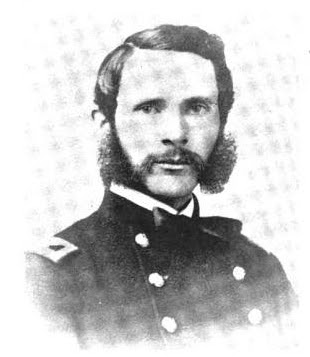
Patrick O'Rorke was born in County Cavan, Ireland 25 march 1837. When just one year old his parents emigrated to America. By 1842 he was living in Rochester, New York. He was an intelligent man, being awarded a scholarship to the University of Rochester when he was 16. He turned down that scholarship in order to help support his mother and the rest of his family.

In 1857 he would become a cadet at the US Military Academy at West Point. He graduated first in his class and was commissioned to the Corps of Engineers in June 1861.

The Civil War
In September 1862 he was appointed colonel of the 140th New York Infantry which was composed mostly of volunteers from Rochester. He led the 140th at the Battles of Fredericksburg and Chancellorsville.

During the second day of the Battle of Gettysburg O'Rorke led his men to the defense of Little Round Top which was in danger of falling into rebel hands. Despite heavy casualties they helped hold the ground. During the fighting O'Rorke caught up his regimental colors and, mounting a rock he urged his men to continue the fight. They pushed back the 4th and 5th Texas. Thirty-Six of their men were killed, 78 wounded, and 18 were missing.

Colonel O'Rorke continued to lead his men for the rest of the war. Two of the more costly battles they fought in were the The Battle of the Wilderness and the Battle of Cold Harbor. At Five Forks, Virginia one of O'Rorke's men, First Sergeant Robert F. Shipley, captured the flag of the 9th Virginia Infantry in hand-to-hand combat. Shipley would be awarded the Congressional Medal or Honor.

New York Assembly
After leaving the Army in late 1869 O'Rorke returned to Rochester with his wife and three children. He was a hero in Rochester and turned that popularity into a successful campaign for New York State Assembly. He ran as a Republican defeating Democrat George D. Lord in the November 1870 election.

In 1874 during the 97th New York State Legislature session he met and befriended fellow Republican Assemblyman, Hamilton Fish II. Fish's father was the U.S. Secretary of State for President Grant's administration.

O'Rorke did not run for re-election in 1876. He had received an offer to help Hamilton Fish, Sr. on an important project in Washington.

US Department of State
Patrick O'Rorke's excellent military record, knowledge of engineering, and connections with Hamilton Fish and President Grant gave him a post with Secretary of State. They wanted his help with negotiations and planning for an inter-oceanic canal in Nicaragua. Negotiations were successfully completed in late March 1877 with O'Rorke's contributions. It was at this point the new President, Rutherford B. Hayes, came into office and created his own cabinet. Hamilton Fish was replaced. Patrick O'Rorke was kept on and placed in charge of the Nicaraguan Canal project.


Nicaraguan Canal Company
After moving his family down to Washington, DC O'Rorke worked full time on the canal project. He would have to spend more than half of his time in Nicaragua surveying sites and overseeing local operations. It was estimated that the project would take fifteen to twenty years to complete. Unlike all estimates it ended up being optimistic – the project took nearly thirty years and cost considerably more blood and treasure than was imagined.

None of the near catastrophic problems with the construction of the canal can be blamed on Patrick O'Rorke however. Unfortunately he died in 1879 of malaria at the age of 42. He left behind his wife, Clara as well has three children – his son Neil, and daughters Mary and Eileen. His body was returned to Rochester and buried in the Holy Sepulchre Cemetary.

It has been wondered by many how the Nicaraguan Canal project would have turned out if Patrick's life had not been cut short. Would he have had the intelligence and strength of character to keep the worst problems from being as severe.
NOTES
Lt. Colonel O'Rorke was killed on 2 July 1863 defending Little Round Top at Gettysburg. He was still young (26 years old) and intelligent. It was 150 years ago today that he died. This is an alternate history to honor one of my hometown's Civil War heroes.

*Patrick O'Rorke over at Wikipedia (a portion of this post is taken from the entry on O'Rorke and the 140th.
*Robert F. Shipley
*140th New York Volunteer Infantry Regiment
The images are also from Wikipedia. Both are public domain due to their age.

01 July 2013

Review - We Could Do Worse

Life's gotten a bit busy! It's been over a week since my last update. Sorry about that. Here's a brief book review until I can finish a couple of meatier posts I'm working on:
(image from Amazon.com)

Here is a collection of alternate histories that includes some big names. Brief descriptions follow... very brief since I wanted to avoid spoilers.

1) A Massachusetts Yankee in King Arthur's Court: by Harry Turtledove. JFK is sent back through time and space to Camelot. He meets and has a fling with Queen Guinevere. No real point to the story. Just makes JFK and the Queen look like jerks. Just involves time travel - not really alternate history.

2) Ike and the Mike: by Howard Waldrop. Instead of becoming generals Eisenhower and Patton are jazz musicians! Good story; not very believable but its not bad.

3) Looking for the Fountain: by Robert Silverberg. The story of one of the survivors of Ponce de León's expedition to search for the Fountain of Youth. A really good story about a lost civilization they discovered instead. Great idea - but there is no follow up, no indication of how history was altered.

4) The Return of William Proxmire: by Larry Niven. An interesting story of what happens to a man who travels back in time to change history and the consequences he suffers. Not one of those ironic Twilight Zone consequences, but a interesting take on what might happen to a time traveler.

5) The Arrival of Truth: by Kristine Kathryn Rusch. The best of the collection of this book. Tells a story from the point of view of a slave in the American south when a slave uprising begins. The most interesting characters in the entire anthology.

6) Goddard's People: by Allen Steele. In a world where America and the Third Reich are in a race involving rocketry. The Nazis want to create an ICBM and the US wants to create something to shoot it down. Interesting, but I'm not sure things would have turned out differently.

7) Over There: by Mike Resnick. I've read this one in other anthologies. Teddy Roosevelt assembles his Rough Riders to fight in the Great War. The old and new worlds collide in this fine story.

8) Bloodstained Ground: by Brian Thomsen. Failed novelist Sam Clemens vs. the legacy of newly deceased President George Armstrong Custer. One of the better stories in this anthology. Even if he failed as a novelist, Clemens would have excelled in whatever else he chose to do.

9) We Could Do Worse: by Gregory Benford. A short piece set in a world where McCarthy became president of the US.

Over all I'd give this book 3 stars. Maybe the low end of 3. While most anthologies end up netting out to about a 3 I had higher hopes for this one. Oh well, better luck next time.

20 June 2013

Greater Canada

Canada


Introduction
A land of vast distances and rich natural resources. Russian Alaska was added in 1856 at the end of the Crimean War. Canada became a self-governing dominion in 1867 while retaining ties to the British crown. Economically and technologically, the nation has developed in parallel with the US, its neighbor to the south across the world's longest unfortified border. In 1962 Canada absorbed the West Indies Federation into its territory. In 1971 Belize also joined Canada. Canada faces the political challenges of meeting public demands for quality improvements in health care, education, social services, and economic competitiveness, as well as responding to the particular concerns of predominantly francophone Quebec. Canada also aims to develop its diverse energy resources while maintaining its commitment to the environment.
Geography
Location: North America
Area: 11,745,729 sq km (10,617,691 land, 1,129,038 water)
Coastline: 216,086 km

Climate: varies from tundra to tropical
People & Society
Nationality: Canadian

Languages: English, French, Spanish

Population: 41,388,622 (December 2012)

Population Growth Rate: 0.84%

Life Expectancy at Birth: 77.91 years male; 83.24 years female
Government
Capital: Ottawa
Administrative Districts: 13 provinces and 3 territories(*); Alaska, Alberta, Belize, British Columbia, Manitoba, New Brunswick, Newfoundland & Labrador, Northwest Territories*, Nova Scotia, Nunavut*, Ontario, Prince Edward Island, Quebec, Saskatchewan, West Indies Federation, Yukon*

Independence: 1 July 1867 (union of British North American colonies); 11 December 1931 (recognized by UK)
National Holiday: Canada Day – 1 July (1867)
Suffrage: 18 years of age; universal

Executive Branch
Head of State: Queen Elizabeth II (since 6 February 1952); represented by Governor General David Johnston (since 1 October 2010)
Head of Government: Prime Minister Stephen Joseph Harper (since 6 February 2006)
cabinet: Federal Ministry chosen by the prime minister usually from among the members of his own party sitting in Parliament elections: the monarchy is hereditary; governor general appointed by the monarch on the advice of the prime minister for a five-year term; following legislative elections, the leader of the majority party or the leader of the majority coalition in the House of Commons generally designated by the governor general.

Legislative branch
Bicameral Parliament or Parlement consists of the Senate or Senat (113 seats; members appointed by the governor general on the advice of the prime minister and serve until 75 years of age) and the House of Commons or Chambre des Communes (365 seats; members elected by direct, popular vote to serve a maximum of four-year terms)
elections: House of Commons - last held on 2 May 2011 (next to be held no later than 19 October 2015)
election results: House of Commons - seats by party - Conservative Party 174, NDP 112, Liberal Party 41, PNP 9, JLP 8, Carribean 8, Bloc Quebecois 4, Greens 3, Alaskan 3, UDP 2, PUP 1

Judicial branch
Supreme Court of Canada (judges are appointed by the governor general on the recommendation of the prime minister); Federal Court of Canada; Federal Court of Appeal; Tax Court of Canada; Provincial/Territorial Courts (these are named variously Court of Appeal, Court of Queen's Bench, Superior Court, Supreme Court, and Court of Justice)
Economy
Overview: An affluent, high-tech industrial society in the trillion-dollar class. Canada has a diverse economy with many similarities to the United States

GDP: $1,800 billion (in 2012 US$)
GDP Per Capita: $43,500 (2012)
GDP Growth Rate: 1.6%

Government Revenues: $793.6 billion
Government Expenditures: $868.4 billion
Public Debt: 88.2% GDP
Inflation Rate: 1.9%

Agriculture Products: wheat, barley, oilseed, tobacco, fruits, vegetables, dairy products, fish, forest products, bananas, cacao, citrus, sugar, shrimp, coffee, yams, ackees, poultry, goats, shellfish, flowers
Industries: transportation equipment, chemicals, processed and unprocessed minerals, food products, wood and paper products, fish products, petroleum and natural gas, garment production, tourism, construction, bauxite/alumina, rum

Currency: Canadian Dollar (CAD)
Energy
Electricity Production: 631.92 billion kWh (2010 est.)
Electricity Consumption: 581.76 billion kWh (2010 est.)
Electricity by Source: Hydroelectric 57.2%, Fossil Fuels: 28.8%, Nuclear: 10.1%, Renewable: 3.9%

Crude Oil Production: 4.371 million bbl/day (2011 est.)
Crude Oil - Proved Reserves: 205.936 billion bbl (2010 est.)
Natural Gas Production: 225.6 billion cu m (2010 est.)
Natural Gas - Proved Reserves: 3.834 trillion cu m (2011)
Communication
Telephones - Main Lines in Use: 12.639 million (2011)
Telephones - Mobile Cellular: 26.922 million (2011)
Internet Country Code: .ca
Internet Hosts: 9.282 million(2012)
Internet Users: 30.67 million (2012)
Transportation
Airports: 1,828 (2012), 662 have paved runways
Heliports: 34 (2012)
Railways: 51,552 km standard gauge
Roadways: 1,107,748 km of which 522,548 km are paved

Ports & Terminals: Anchorage, Belize City, Big Creek, Cayman Brac, Discovery Bay (Port Rhoades), Fraser River Port, George Town, Halifax, Hamilton, Juneau, Ketchikan, Kingston, Montego Bay, Montreal, Port-Cartier, Port Esquivel, Port Fortin, Port Kaiser, Port Lisas, Port Spain, Quebec City, Rocky Point, Saint John (New Brunswick), Scarborough, Sept-Isles, Sitka, Skagway, Vancouver
Military
Canadian Forces: Canadian Army, Royal Canadian Navy, Royal Canadian Air Force, Canada Command (homeland security)

Military Expenditures as portion of GDP: 1.3%
Transnational Issues
US works closely with Canada to intensify security measures for monitoring and controlling legal and illegal movement of people, transport, and commodities across the international border; sovereignty dispute with Denmark over Hans Island in the Kennedy Channel between Ellesmere Island and Greenland; commencing the collection of technical evidence for submission to the Commission on the Limits of the Continental Shelf in support of claims for continental shelf beyond 200 nautical miles from its declared baselines in the Arctic, as stipulated in Article 76, paragraph 8, of the United Nations Convention on the Law of the Sea

Guatemala persists in its territorial claim to half of Belize, but agrees to the Line of Adjacency to keep Guatemalan squatters out of Belize's forested interior; both countries agreed in April 2012 to hold simultaneous referenda, scheduled for 6 October 2013, to decide whether to refer the dispute to the ICJ for binding resolution; Belize and Mexico are working to solve minor border demarcation discrepancies arising from inaccuracies in the 1898 border treaty

Illicit drugs
illicit producer of cannabis for the domestic drug market and export to US; use of hydroponics technology permits growers to plant large quantities of high-quality marijuana indoors; increasing ecstasy production, some of which is destined for the US; vulnerable to narcotics money laundering because of its mature financial services sector

transshipment point for cocaine from South America to North America and Europe; illicit cultivation and consumption of cannabis; government has an active manual cannabis eradication program; corruption is a major concern; substantial money-laundering activity; Colombian narcotics traffickers favor Jamaica for illicit financial transactions


NOTES
1) The CIA World Factbook was an ideal reference when coming up with this post.
2) The Wikipedia article on the West Indies Federation was also of help.
3) The map image is a modified version of the Canadian one on Wikipedia.
4) The flag is a combination of the flags of the West Indies Federation and Canada.
Related Posts Plugin for WordPress, Blogger...